InverseLaplaceTransform[F[s],s, ]
]
gives the numeric inverse Laplace transform at the numerical value  .
.




InverseLaplaceTransform
InverseLaplaceTransform[F[s],s,t]
gives the symbolic inverse Laplace transform of F[s] in the variable s as f[t] in the variable t.
InverseLaplaceTransform[F[s],s, ]
]
gives the numeric inverse Laplace transform at the numerical value  .
.
InverseLaplaceTransform[F[s1,…,sn],{s1,s2,…},{t1,t2,…}]
gives the multidimensional inverse Laplace transform of F[s1,…,sn].
Details and Options
- Laplace transforms are typically used to transform differential and partial differential equations to algebraic equations, solve and then inverse transform back to a solution.
- Laplace transforms are also extensively used in control theory and signal processing as a way to represent and manipulate linear systems in the form of transfer functions and transfer matrices. The Laplace transform and its inverse are then a way to transform between the time domain and frequency domain.
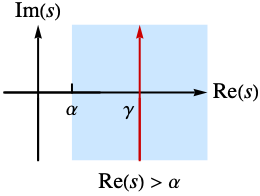
- The inverse Laplace transform of a function
 is defined to be
  , where γ is an arbitrary positive constant chosen so that the contour of integration lies to the right of all singularities in
  .
. - The multidimensional inverse Laplace transform of a function
 is given by a contour integral of the form
  .
. - The integral is computed using numerical methods if the third argument
 is given a numerical value. The available method settings include "Crump", "Durbin", "Papoulis", "Piessens", "Stehfest", "Talbot" and "Weeks".
 - The asymptotic inverse Laplace transform can be computed using Asymptotic.
- The following options can be given:
-
AccuracyGoal Automatic digits of absolute accuracy sought Assumptions $Assumptions assumptions to make about parameters GenerateConditions False whether to generate answers that involve conditions on parameters Method Automatic method to use PerformanceGoal $PerformanceGoal aspects of performance to optimize PrecisionGoal Automatic digits of precision sought WorkingPrecision Automatic the precision used in internal computations - In TraditionalForm, InverseLaplaceTransform is output using ℒ-1. »
Examples
open all close allBasic Examples (4)
Compute the inverse Laplace transform of a function:
InverseLaplaceTransform[(1/s + 1), s, t]Inverse Laplace transform of a function with parameters:
InverseLaplaceTransform[Log[(s + a/s + b)], s, t]Plot[Evaluate[Table[% /. a -> 1, {b, 2, 5}]], {t, 0, 4}]Compute a numerical inverse Laplace transform:
InverseLaplaceTransform[(1/s ^ (3 / 2) + s ^ 2 + 1), s, 0.3]Inverse Laplace transform of a bivariate function:
InverseLaplaceTransform[(1/Sqrt[1 + p q]), {p, q}, {x, y}]Scope (56)
Basic Uses (3)
Compute the inverse Laplace transform of a function for a symbolic parameter t:
InverseLaplaceTransform[(1/Sqrt[s + 1]), s, t]Use a numerical value for the parameter:
InverseLaplaceTransform[(1/Sqrt[s + 1]), s, 1.2]TraditionalForm formatting:
TraditionalForm[InverseLaplaceTransform[f[t], t, s]]Rational Functions (5)
Reciprocal of a linear function:
InverseLaplaceTransform[(1/a s + b), s, t]Reciprocal of a quadratic function:
InverseLaplaceTransform[(1/a s^2 + b s + c), s, t]Functions whose inverses are trigonometric functions:
InverseLaplaceTransform[(a/s^2 + a^2), s, t]InverseLaplaceTransform[(s/s^2 + a^2), s, t]Functions whose inverses are hyperbolic functions:
InverseLaplaceTransform[(a/s^2 - a^2), s, t]//FullSimplifyInverseLaplaceTransform[(s/s^2 - a^2), s, t]//FullSimplifyMore examples of rational functions:
InverseLaplaceTransform[(s/(s^2 + a^2)^2), s, t]InverseLaplaceTransform[(s/(s^2 + a^2)(s^2 + b^2)), s, t]InverseLaplaceTransform[(s^2/(s^2 - a^2)(s^2 - b^2)), s, t]//FullSimplifyElementary Functions (5)
Function involving a square root:
InverseLaplaceTransform[(1/s Sqrt[s + 1]), s, t]Function involving exponential and square root functions:
InverseLaplaceTransform[Exp[-5s](1/Sqrt[s](s - 2)), s, t]InverseLaplaceTransform[(1/ Sqrt[s + a] + b), s, t]InverseLaplaceTransform[(Sqrt[s + b]/s + a), s, t]Inverse Laplace transform leading to a Bessel function:
InverseLaplaceTransform[(1/Sqrt[s^2 + b s + a^2]), s, t]Inverse of an arctangent function:
InverseLaplaceTransform[ArcTan[(1/2s)], s, t]Logarithmic Functions (4)
Inverse Laplace transform of a logarithmic function:
InverseLaplaceTransform[(Log[s]/s - 1), s, t]Logarithm of a rational function:
InverseLaplaceTransform[Log[(s^2 + 1/s^2 + 2)], s, t]Plot[%, {t, 0, 15}]Product of a logarithm and a power function:
InverseLaplaceTransform[(Log[4 s] /s^1 / 3), s, t]Function involving the square of a logarithm:
InverseLaplaceTransform[(Log[s]^2/s), s, t]Special Functions (12)
Function involving BesselK:
InverseLaplaceTransform[(BesselK[4, Sqrt[s]]/s^2), s, t]Ratio of an incomplete gamma function and a power function:
InverseLaplaceTransform[(Gamma[(1/3), s]/s^(1/3)), s, t]Inverse of a polygamma function:
InverseLaplaceTransform[PolyGamma[7, s], s, t]Inverse of a function involving an error function:
InverseLaplaceTransform[Exp[9s^2]Erfc[3s], s, t]Error function composed with a square root:
InverseLaplaceTransform[Erfc[ Sqrt[3s]], s, t]InverseLaplaceTransform[(Erf[ Sqrt[2s]]/Sqrt[s]), s, t]Inverse transforms of the LegendreP and LegendreQ functions:
InverseLaplaceTransform[LegendreP[-3 / 5, s], s, t]InverseLaplaceTransform[LegendreQ[3 / 5, s], s, t]Complex plots of the Legendre functions:
{ComplexPlot[LegendreP[-3 / 5, s], {s, -3 - 3I, 3 + 3I}],
ComplexPlot[LegendreQ[+3 / 5, s], {s, -3 - 3I, 3 + 3I}]}InverseLaplaceTransform[Exp[-2 s]BesselI[0, 2 s], s, t]ComplexPlot of the frequency-domain function:
ComplexPlot[Exp[-2 s]BesselI[0, 2 s], {s, -3 - 3I, 3 + 3I}]Product of BesselJ and Gamma functions:
InverseLaplaceTransform[(2 / 5)^sGamma[s]BesselJ[1 / 2 + s, 5], s, t]ComplexPlot of the frequency-domain function:
ComplexPlot[(Gamma[s]/(5 / 2)^s)BesselJ[1 / 2 + s, 5], {s, -3 - 2I, 3 + 2I}]Composition of exponential integral and square root functions:
InverseLaplaceTransform[(ExpIntegralEi[-5 Sqrt[s]]/Sqrt[s]), s, t]Product of two ParabolicCylinderD functions:
InverseLaplaceTransform[ParabolicCylinderD[-1 / 3, Sqrt[s + Sqrt[s^2 - 4]]]ParabolicCylinderD[-1 / 3, Sqrt[s - Sqrt[s^2 - 4]]], s, t]Inverse transforms involving elliptic integral functions:
InverseLaplaceTransform[EllipticK[a^2 / s^2] - π / 2, s, t]InverseLaplaceTransform[s(π / 2 - EllipticE[a^2 / s^2]), s, t]Inverse transform of EllipticTheta:
InverseLaplaceTransform[(EllipticTheta[2, 0, Exp[-Pi^2s] ]/s), s, t]Piecewise Functions (5)
The inverse of the following function is a piecewise function:
InverseLaplaceTransform[(Exp[-3s]/s + 1), s, t]Plot[%, {t, 0, 8}, PlotRange -> All]Inverse of an exponential function leading to a box function:
InverseLaplaceTransform[(Exp[-2s] - Exp[-5s]/s), s, t]Plot[%, {t, 0, 8}]Inverse of an exponential function leading to a piecewise trigonometric function:
InverseLaplaceTransform[((1 - Exp[-6s])/s^2 + 1), s, t]Plot[%, {t, 0, 27}]Inverse leading to a staircase function:
InverseLaplaceTransform[(1/s Sinh[3s]), s, t]Activate[%]Plot[%, {t, 0, 40}, Exclusions -> None]More involved staircase function:
InverseLaplaceTransform[(1/s Sinh[3s]Sinh[5s]), s, t]TruncateSum[%, 45];Plot[%, {t, 0, 60}]Periodic Functions (4)
The inverse of the following function is periodic with respect to t:
InverseLaplaceTransform[(1/s(Exp[s] + 1)), s, t]Assuming[t > 0, FullSimplify[Activate[%]]]Plot to verify that the result is a square wave:
Plot[%, {t, 0, 7}]Function whose inverse is the absolute value of the sine function:
InverseLaplaceTransform[(1/s^2 + 1)Coth[π (s/2)], s, t]Plot[Evaluate[Activate[%]//FullSimplify], {t, 0, 10}]Function whose inverse is a trapezoidal wave:
InverseLaplaceTransform[((1 - E^-3 s) (1 - E^-s)/2 (1 - E^-4 s) s^2), s, t]Plot[Evaluate[Activate[%]], {t, 0, 14}]A more involved piecewise example:
InverseLaplaceTransform[((Exp[s] - 1) Sin[π / 5]/s(Exp[2s] - 2 Exp[s]Cos[π / 5] + 1)), s, t]Plot[{Evaluate[TruncateSum[%, 6]], Sin[π Floor[t] / 5]}, {t, 0, 15}]Generalized Functions (3)
Inverse of an exponential function is the Dirac function:
InverseLaplaceTransform[Exp[-s], s, t]Inverse of the product of an exponential function and a power of s is a derivative of the Dirac function:
InverseLaplaceTransform[Exp[-s]s ^ 2, s, t]The inverse of the hyperbolic secant is a series of Dirac functions:
InverseLaplaceTransform[Sech[s], s, t]InverseLaplaceTransform[Coth[3s], s, t]Multivariate Functions (8)
Inverse Laplace transform of a bivariate rational function:
InverseLaplaceTransform[(1/p + q), {p, q}, {x, y}]LaplaceTransform[%, {x, y}, {p, q}]Rational function that is separable with respect to p and q:
InverseLaplaceTransform[(1/(-a + p) (-b + q)), {p, q}, {x, y}]Rational function that is not separable with respect to p and q:
InverseLaplaceTransform[(1/(q - 1)(p + q)), {p, q}, {x, y}]Rational function whose inverse is related to BesselJ:
InverseLaplaceTransform[(1/1 + p q), {p, q}, {x, y}]Inverse Laplace transform of a bivariate function involving a radical:
InverseLaplaceTransform[(1/Sqrt[p + q]), {p, q}, {x, y}]Inverse Laplace transform of a multivariate function in three variables:
InverseLaplaceTransform[(1/p^mq^nr^k), {p, q, r}, {x, y, z}]InverseLaplaceTransform[-(p + q + r - p q r/(1 + p^2) (1 + q^2) (1 + r^2)), {p, q, r}, {x, y, z}]//SimplifyFunction involving a logarithm:
InverseLaplaceTransform[-(3 EulerGamma + Log[p q r]/p q r), {p, q, r}, {x, y, z}]Numerical Inversion (4)
Calculate the inverse Laplace transform at a single point:
InverseLaplaceTransform[(s/(s + 2)^2), s, 2.3]Alternatively, calculate the inverse Laplace transform symbolically:
InverseLaplaceTransform[(s/(s + 2)^2), s, t]Then evaluate it for a specific value of t:
% /. t -> 2.3Plot the inverse Laplace transform numerically and compare it with the exact result:
f[t_ ? NumericQ] := InverseLaplaceTransform[(s/(s + 2)^2), s, t]g[t_] = InverseLaplaceTransform[(s/(s + 2)^2), s, t]Show[
DiscretePlot[f[t], {t, 0, 5, 0.1}, PlotStyle -> Red, PlotRange -> All],
Plot[g[t], {t, 0, 5}, PlotRange -> All]
]Function whose inverse is a piecewise function with respect to t:
f[t_ ? NumericQ] := InverseLaplaceTransform[((1 - Exp[-s])^2/s), s, t, Method -> "Durbin"]f[0.7]DiscretePlot[f[t], {t, 0.1, 6, 0.1}]Function whose inverse is a periodic function with respect to t:
f[t_ ? NumericQ] := InverseLaplaceTransform[((1 - Exp[-3s]) (1 - Exp[-s])/2 (1 - Exp[-4s]) s^2), s, t, Method -> "Durbin"]f[0.7]DiscretePlot[f[t], {t, 0.1, 12, 0.2}]Fractional Calculus (3)
ComplexPlot of an algebraic function in the  -domain:
ComplexPlot[(s^2 / 3/(s^2 / 3 - 1) (2s^2 / 3 + 5)), {s, -2 - 2I, 2 + 2I}]Inverse Laplace transform of this algebraic function:
InverseLaplaceTransform[(s^2 / 3/(s^2 / 3 - 1) (2s^2 / 3 + 5)), s, t]Laplace transform to the  -domain:
LaplaceTransform[%, t, s]//SimplifyInverse Laplace transform of the algebraic function:
f[t_] = InverseLaplaceTransform[(7s^1 / 5 - 6/-1 + 3 s^1 / 5 - 4 s^2 / 5 + 12 s^3 / 5), s, t]Plot[f[t], {t, 0, 20}]Laplace transform to the  -domain:
LaplaceTransform[f[t], t, s]//SimplifyInverse Laplace transform of the algebraic function involving parameters:
InverseLaplaceTransform[(s^-β/1 - a s^-α), s, t, Assumptions -> α > 0 && β > 0]Laplace transform to the  -domain:
LaplaceTransform[%, t, s]Options (3)
GenerateConditions (1)
By default, InverseLaplaceTransform assumes that the result is defined for non-negative t:
InverseLaplaceTransform[1 / s ^ 2, s, t]Use GenerateConditions to obtain the range of validity for the result:
InverseLaplaceTransform[1 / s ^ 2, s, t, GenerateConditions -> True]LaplaceTransform[%, t, s]Method (1)
Use the default method for numerical evaluation:
InverseLaplaceTransform[(1/Sqrt[s + 1] + s), s, 5.3]Use Method to obtain the result from different methods:
InverseLaplaceTransform[(1/Sqrt[s + 1] + s), s, 5.3, Method -> #]& /@ {"Stehfest", "Piessens", "Talbot", "Durbin", "Crump", "Papoulis", "Weeks"}//ChopWorking Precision (1)
Use WorkingPrecision to obtain a result with arbitrary precision:
InverseLaplaceTransform[(15Exp[-1 / Sqrt[s]]) / (s^5 / 3 + 1), s, 0.3]InverseLaplaceTransform[(15Exp[-1 / Sqrt[s]]) / (s^5 / 3 + 1), s, 0.3, WorkingPrecision -> 10]InverseLaplaceTransform[(15Exp[-1 / Sqrt[s]]) / (s^5 / 3 + 1), s, 0.3, WorkingPrecision -> 20]Applications (5)
Compute the step response to the linear system with transfer function  :
:
InverseLaplaceTransform[1 / (s ^ 2 + s + 1) 1 / s, s, t]Plot[%, {t, 0, 10}]Solve a differential equation using Laplace transforms:
LaplaceTransform[f''[t] + f[t] == E ^ (-3t), t, s]Solve for the Laplace transform:
Solve[%, LaplaceTransform[f[t], t, s]]InverseLaplaceTransform[%, s, t]sol1 = f[t] /. %[[1]] /. {f[0] -> 1, f'[0] -> 3}Find the solution directly using DSolve:
sol2 = f[t] /. DSolve[{f''[t] + f[t] == Exp[-3t], f[0] == 1, f'[0] == 3}, f[t], t][[1]]Simplify[sol1 - sol2]Solve a fractional-order differential equation of order 3/2:
eqn = CaputoD[y[t], {t, 3 / 2}] - D[y[t], {t, 1}] == t;Solve for the Laplace transform:
Solve[LaplaceTransform[eqn, t, s] /. {y[0] -> 0, y'[0] -> 1}, LaplaceTransform[y[t], t, s]]InverseLaplaceTransform[%, s, t]Plot[y[t] /. %, {t, 0, 4}]Find the solution directly using DSolve:
DSolve[{CaputoD[y[t], {t, 3 / 2}] - D[y[t], {t, 1}] == t, y[0] == 0, y'[0] == 1}, y[t], t]Solve a fractional-order differential equation of order 21/10:
LaplaceTransform[CaputoD[y[t], {t, 21 / 10}] + 10y[t] == 0, t, s] /. {y[0] -> 1, y'[0] -> 0, y''[0] -> 0}Solve for the Laplace transform:
Solve[%, LaplaceTransform[y[t], t, s]]InverseLaplaceTransform[%, s, t]Plot[y[t] /. %, {t, 0, 10}]Find the solution directly using DSolve:
DSolve[{CaputoD[y[t], {t, 21 / 10}] + 10y[t] == 0, y[0] == 1, y'[0] == 0, y''[0] == 0}, y[t], t]Solve a system of fractional DEs using LaplaceTransform:
Solve[LaplaceTransform[{CaputoD[y[t], {t, 1 / 3}] == -z[t], CaputoD[z[t], {t, 1 / 3}] == y[t]}, t, s] /. {y[0] -> 1, z[0] -> 0}, LaplaceTransform[{y[t], z[t]}, t, s]]InverseLaplaceTransform[%, s, t]Properties & Relations (2)
Use Asymptotic to compute an asymptotic approximation:
Asymptotic[Inactive[InverseLaplaceTransform][1 / Sqrt[s ^ 5 + 1], s, t], t -> 0]InverseLaplaceTransform and LaplaceTransform are mutual inverses:
LaplaceTransform[InverseLaplaceTransform[f[s], s, t], t, s]InverseLaplaceTransform[LaplaceTransform[g[t], t, s], s, t]InverseLaplaceTransform[1 / (s ^ 2 + 1), s, t]LaplaceTransform[%, t, s]Neat Examples (2)
InverseLaplaceTransform of a MeijerG function:
InverseLaplaceTransform[MeijerG[{{1 / 3}, {}}, {{0, 1 / 3, 1 / 3, 2 / 3}, {}},
    s ^ 3 / 27] / (2 * Sqrt[3] * Pi), s, t]
Create a table of basic inverse Laplace transforms:
Flist = {1, 1 / (s - a), 1 / s ^ 2, a / (a ^ 2 + s ^ 2), s / (a ^ 2 + s ^ 2), s / (s ^ 2 - a ^ 2) ^ 2, 1 / Sqrt[s + a], 1 / (s * Sqrt[s]),
    1 / (s * Sqrt[s + a]), 1 / Sqrt[s ^ 2 + a ^ 2], Exp[-a / s] / Sqrt[s], Exp[(-a) * Sqrt[s]] / Sqrt[s], Exp[(-a) * Sqrt[s]] / s,
Log[s] / s, Log[(s + a) / (s + b)]};Grid[Prepend[{#, Assuming[{a > 0}, Simplify[InverseLaplaceTransform[#1, s, t]]]}& /@ Flist, {F[s], InverseLaplaceTransform[F[s], s, t]}], IconizedObject[«Grid options»]]//TraditionalFormRelated Links

 MathWorld
Text
Wolfram Research (1999), InverseLaplaceTransform, Wolfram Language function, https://reference.wolfram.com/language/ref/InverseLaplaceTransform.html (updated 2023).
CMS
Wolfram Language. 1999. "InverseLaplaceTransform." Wolfram Language & System Documentation Center. Wolfram Research. Last Modified 2023. https://reference.wolfram.com/language/ref/InverseLaplaceTransform.html.
APA
Wolfram Language. (1999). InverseLaplaceTransform. Wolfram Language & System Documentation Center. Retrieved from https://reference.wolfram.com/language/ref/InverseLaplaceTransform.html