



RegionDimension
RegionDimension[reg]
gives the geometric dimension of the region reg.
Details and Options
- The geometric dimension d of reg is the largest d such that a d-dimensional ball can be completely embedded in the region.
- Typical names for regions of different dimensions include:
-
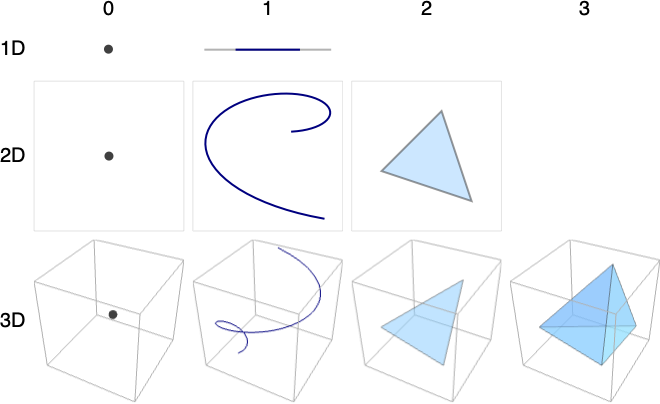
0 points 1 lines, curves, arcs, segments, intervals 2 planes, surfaces 3 solids, volumes - Example cases with rows corresponding to embedding dimension and columns to RegionDimension:
- RegionDimension takes an Assumptions option that can be used to specify assumptions on parameters.
Examples
open all close allBasic Examples (4)

RegionDimension[Point[{0}]]RegionDimension[Interval[{1, 2}]]
RegionDimension[Point[{0, 0}]]RegionDimension[Line[{{0, 0}, {1, 1}}]]RegionDimension[Rectangle[]]
RegionDimension[Point[{0, 0, 0}]]RegionDimension[Line[{{0, 0, 0}, {1, 1, 1}}]]RegionDimension[Sphere[]]RegionDimension[Ball[]]
RegionDimension[Point[{0, 0, 0, 0}]]RegionDimension[Line[{{0, 0, 0, 0}, {1, 1, 1, 1}}]]RegionDimension[InfinitePlane[{{0, 0, 0, 0}, {1, 0, 0, 0}, {0, 1, 0, 0}}]]RegionDimension[Sphere[{0, 0, 0, 0}, 1]]RegionDimension[Ball[{0, 0, 0, 0}, 1]]Scope (19)
Special Regions (4)
Regions in  including Point:
RegionDimension[Point[{{0}, {1}}]]ℛ = Interval[{1, 2}];
NumberLinePlot[ℛ]RegionDimension[ℛ]Regions in  including Point:
ℛ = Point[Tuples[Range[5], 2]];
Region[ℛ]RegionDimension[ℛ]Line:
ℛ = Line[{{1, 2}, {4, 3}}];
Region[ℛ]RegionDimension[ℛ]ℛ = Circle[{1, 2}, 3];
Region[ℛ]RegionDimension[ℛ]Disk:
ℛ = Disk[{1, 2}, {4, 3}];
Region[ℛ]RegionDimension[ℛ]Regions in  including Point:
ℛ = Point[Tuples[Range[5], 3]];
Region[ℛ]RegionDimension[ℛ]Line:
ℛ = Line[{{1, 2, 3}, {6, 5, 4}}];
Region[ℛ]RegionDimension[ℛ]ℛ = Polygon[{{0, 0, 0}, {(5/3), (2/3), -(4/3)}, {(2/3), (2/3), -(1/3)}, {1, 2, 0}}];
Region[ℛ]RegionDimension[ℛ]ℛ = Cylinder[{{0, 0, 0}, {1, 1, 1}}, 2];
Region[ℛ]RegionDimension[ℛ]Regions in  including Simplex in
  :
:
RegionDimension[Simplex[{{1, 0, 0, 0}, {0, 1, 0, 0}, {0, 0, 1, 0}, {0, 0, 0, 1}}]]Cuboid in  :
:
RegionDimension[Cuboid[{1, 2, 3, 4, 5}, {6, 7, 8, 9, 10}]]Ball in  :
:
RegionDimension[Ball[{1, 2, 3, 4, 5, 6, 7}, 8]]Formula Regions (3)
The dimension of a disk represented as an ImplicitRegion:
ℛ = ImplicitRegion[x^2 + y^2 ≤ 1, {x, y}];Region[ℛ]RegionDimension[ℛ]RegionDimension[ImplicitRegion[x^2 + y^2 ≤ 1, {x, y, {z, 0, 2}}]]The dimension of a disk represented as a ParametricRegion:
RegionDimension[ParametricRegion[{r Cos[θ], r Sin[θ]}, {{r, 0, 1}, {θ, 0, 2π}}]]Using a rational parametrization of the disk:
RegionDimension[ParametricRegion[{r(1 - t^2/1 + t^2), r(2t/1 + t^2)}, {t, {r, 0, 1}}]]RegionDimension[ParametricRegion[{r Cos[θ], r Sin[θ], z}, {{r, 0, 1}, {θ, 0, 2π}, {z, 0, 2}}]]ImplicitRegion can have several components of different dimension:
ℛ = ImplicitRegion[x^2 + y^2 ≤ 1∨x == y, {x, y}];DiscretizeRegion[ℛ, {{-2, 2}, {-2, 2}}]RegionDimension gives the largest dimension:
RegionDimension[ℛ]Mesh Regions (4)
The dimension of a BoundaryMeshRegion:
BoundaryMeshRegion[{{0}, {1}}, Point[{{1}, {2}}]]RegionDimension[%]ConvexHullMesh[RandomReal[1, {10, 2}]]RegionDimension[%]ConvexHullMesh[RandomReal[1, {20, 3}]]RegionDimension[%]The dimension of a MeshRegion:
DelaunayMesh[RandomReal[1, {10, 2}]]RegionDimension[%]DelaunayMesh[RandomReal[1, {20, 3}]]RegionDimension[%]MeshRegion[{{0, 0}, {1, 0}, {2, -1}, {2, 1}}, {Line[{{1, 2, 3, 4, 2}}]}]RegionDimension[%]A MeshRegion can have components of different dimension:
MeshRegion[{{0, 0}, {1, 0}, {2, -1}, {2, 1}}, {Line[{{1, 2}}], Polygon[{{2, 3, 4}}]}]The RegionDimension is the largest dimension:
RegionDimension[%]Derived Regions (4)
The dimension of a RegionIntersection:
ℛ = RegionIntersection[Disk[{0, 0}, 1], Disk[{0, 1}, 1]];Region[ℛ]RegionDimension[ℛ]The dimension of a TransformedRegion:
ℛ = TransformedRegion[Disk[{0, 0}, 1], ScalingTransform[{3, 2}]];DiscretizeRegion[ℛ, {{-3, 3}, {-2, 2}}]RegionDimension[ℛ]The dimension of a RegionBoundary:
ℛ = RegionBoundary[Ball[]];Region[ℛ]RegionBoundary for a full-dimensional region is less than the original dimension:
{RegionDimension[ℛ], RegionDimension[Ball[]]}RegionDimension for an intersection can be less than the original dimensions:
{Subscript[ℛ, 1], Subscript[ℛ, 2]} = {Rectangle[{0, 0}, {1, 1}], Rectangle[{1, 0}, {2, 1}]};ℬ = RegionIntersection[Subscript[ℛ, 1], Subscript[ℛ, 2]];Graphics[{{LightBlue, Subscript[ℛ, 1]}, {LightRed, Subscript[ℛ, 2]}, Line[{{1, 0}, {1, 1}}]}]{RegionDimension[ℬ], RegionDimension[Subscript[ℛ, 1]], RegionDimension[Subscript[ℛ, 2]]}The dimension can drop by more than one:
{Subscript[ℛ, 1], Subscript[ℛ, 2]} = {Rectangle[{0, 0}, {1, 1}], Rectangle[{1, -1}, {2, 0}]};ℬ = RegionIntersection[Subscript[ℛ, 1], Subscript[ℛ, 2]];Graphics[{{LightBlue, Subscript[ℛ, 1]}, {LightRed, Subscript[ℛ, 2]}, Point[{1, 0}]}]{RegionDimension[ℬ], RegionDimension[Subscript[ℛ, 1]], RegionDimension[Subscript[ℛ, 2]]}Geographic Regions (2)
Polygons with GeoPosition:
ℛ = Polygon[GeoPosition[{{{40.083441, -88.235716}, {40.083607, -88.257488}, {40.082603, -88.257149},
   {40.076136999999996, -88.25740499999999}, {40.076178, -88.270888}, {40.076516, -88.271558},
   {40.083686, -88.271512}, {40.083659999999995, -88.267046},  ... 33323}, {40.098112, -88.228687},
   {40.095216, -88.228627}, {40.095179, -88.238547}, {40.094480999999995, -88.238546},
   {40.094508999999995, -88.23267}, {40.094106, -88.232556}, {40.090666999999996, -88.232477},
{40.090741, -88.235745}}}]];RegionDimension[ℛ]Polygons with GeoPositionXYZ:
ℛ = Polygon[GeoPositionXYZ[{{{150451.6968462432, -4.884430486484052*^6, 4.085078564164219*^6},
   {148595.27532671497, -4.884475441490381*^6, 4.085092666620835*^6},
   {148626.35829777512, -4.884546311005128*^6, 4.0850073717259285*^6},
   {148618.5908634042 ... 7*^6, 4.0860187668081024*^6},
   {150697.56410771207, -4.8836599487428395*^6, 4.085984535480795*^6},
   {150711.88303095422, -4.883905546449982*^6, 4.0856924143435075*^6},
{150433.15479548014, -4.883908845676418*^6, 4.0856987003255524*^6}}}]];RegionDimension[ℛ]Polygons with GeoPositionENU:
ℛ = Polygon[GeoPositionENU[{{{3378.2547059731055, -3369.2234780923936, -0.7440009205072329},
   {1521.3211635380246, -3351.391253626573, -0.022340134218666208},
   {1550.2571145363192, -3462.8657556618973, -0.08899812728964207},
   {1528.5672303494055, -418 ... 63383291193, -0.37494203351275246},
   {3654.121991908476, -2566.7472331234085, -0.5214977847472255},
   {3375.420726854886, -2558.6597093173914, -0.3648706331350695}}},
GeoPosition[{40.11379115639895, -88.2753251202516, -1.0415787873318691}]]];RegionDimension[ℛ]Polygons with GeoGridPosition:
ℛ = Polygon[GeoGridPosition[{{{-0.9950503945490105, 1.2366760550756015},
   {-0.9952074890903578, 1.2369207053693891}, {-0.9952196732768064, 1.2369073327446167},
   {-0.9953160063787643, 1.236848436956935}, {-0.9954141759436825, 1.2369993898475449},
   {-0. ... 197645333103}, {-0.9949098578570917, 1.2368130881428654},
   {-0.9948663952535768, 1.2367477711687371}, {-0.9948714472169538, 1.2367426500757825},
{-0.9949211061652593, 1.2367089232486177}, {-0.9949439717990124, 1.236746107097628}}}, "Bonne"]];RegionDimension[ℛ]CSG Regions (1)
The dimension of a CSGRegion in 2D:
ℛ = CSGRegion["Difference", {Disk[], Disk[{1 / 2, 1 / 2}]}]RegionDimension[ℛ]ℛ = CSGRegion["Difference", {Cube[2], Cylinder[{{1, 1, 1}, {1, -1, 1}}]}]RegionDimension[ℛ]Subdivision Regions (1)
The dimension of a SubdivisionRegion in 2D:
ℛ = SubdivisionRegion[Rectangle[]]RegionDimension[ℛ]ℛ = SubdivisionRegion[Tetrahedron[]]RegionDimension[ℛ]Applications (8)
A zero-dimensional object is a collection of points:
pts = Point[RandomReal[1, {70, 2}]];Region[pts]RegionDimension[pts]A one-dimensional object is a collection of curves:
lines = Table[Line[RandomReal[1, {2, 2}]], {40}];circles = Table[Circle[pt, 0.2], {pt, RandomReal[1, {10, 2}]}];curves = Join[lines, circles];Graphics[curves]RegionDimension[RegionUnion@@curves]A two-dimensional object is a collection of surfaces:
surfaces = {Disk[{-0.5, 0.5}, 0.3], Rectangle[{-1, 1}], Triangle[]};Graphics[surfaces]RegionDimension[RegionUnion@@surfaces]Use RegionDimension to tell the difference between a volume and a surface:
regs = {Ball[], Sphere[]};Regions may be visually identical:
Region /@ regsRegionDimension /@ regsCompute dimension of regions that cannot be visualized:
ℛ = RegionProduct[Ball[], Cuboid[{0, 0, 0}, {1, 1, 1}]];RegionDimension[ℛ]The unit for RegionMeasure is  with
with  the length unit and
  :
:
len = 2;regs = {Line[{{0, 0}, {0, len}}], Rectangle[{0, 0}, {len, len}], Cuboid[{0, 0, 0}, {len, len, len}]};Compute the measure of each region:
dims = RegionDimension /@ regslen ^ dimsCompare with the result from RegionMeasure:
RegionMeasure /@ regsExtract MeshRegion primitives by dimension using MeshPrimitives:
ℛ = MeshRegion[{{0, 0, 0}, {2, 0, 0}, {2, 2, 0}, {0, 2, 0}, {1, 1, 2}}, Tetrahedron[{{1, 2, 3, 5}, {1, 3, 4, 5}}]]prims = Table[MeshPrimitives[ℛ, d], {d, {0, 1, 2}}];Table[Graphics3D[p, Boxed -> False], {p, prims}]RegionDimension /@ RegionUnion@@@primsSelect only full-dimensional primitives:
prims = {Line[{{1}, {3}}], Line[{{0, 0}, {1, 1}}], Circle[], Disk[]};Select[prims, RegionDimension[#] === RegionEmbeddingDimension[#]&]Properties & Relations (8)
RegionDimension gives the largest dimension among parts of varying dimension:
mr = MeshRegion[{{0, 0}, {1, 0}, {2, 0}, {3, -1 / 2}, {3, 1 / 2}}, {Point[{1}], Line[{2, 3}], Polygon[{3, 4, 5}]}]The RegionDimension is the largest dimension:
RegionDimension[mr]RegionEmbeddingDimension is the dimension of the space in which a region exists:
ℛ = Circle[];{RegionDimension[ℛ], RegionEmbeddingDimension[ℛ]}It is always greater than or equal to RegionDimension:
ℛ = Ball[{0, 0, 0, 0}, 1];{RegionDimension[ℛ], RegionEmbeddingDimension[ℛ]}DimensionalMeshComponents separates a mesh in different dimensional parts:
mr = MeshRegion[{{0, 0}, {1, 0}, {2, 0}, {3, -1 / 2}, {3, 1 / 2}}, {Point[{1}], Line[{2, 3}], Polygon[{3, 4, 5}]}]dmc = DimensionalMeshComponents[mr]RegionDimension /@ dmcRegionMeasure and RegionCentroid are dimension dependent:
p = {Line[{{0, 0}, {2, 2}}], Rectangle[{0, 0}, {2, 2}], Cuboid[{0, 0, 0}, {2, 2, 2}]};RegionDimension /@ pc = RegionCentroid /@ pm = RegionMeasure /@ pIntegration over a region is dimension dependent:
ℛ = Sphere[{1, 2, 3}]RegionDimension[ℛ]Since the dimension is 2, integration corresponds to a surface integral:
Integrate[1, p∈ℛ]Area[ℛ]The RegionDimension of a RegionBoundary is one less than that of the input:
ℛ = Cuboid[{0, 0, 0}, {1, 1, 1}];RegionDimension /@ {ℛ, RegionBoundary[ℛ]}The RegionDimension of a RegionUnion is equal to the largest input dimension:
{r1, r2, r3} = {Disk[], Rectangle[], Line[{{4, 4}, {5, 5}}]};ℛ = RegionUnion[r1, r2, r3];RegionDimension[ℛ] == Max[RegionDimension /@ {r1, r2, r3}]RegionDimension of a RegionIntersection is no larger than the smallest input dimension:
ℛ = RegionIntersection[Disk[{0, 0}, 1], Disk[{0, 1}, 1]];Region[ℛ]RegionDimension[ℛ]ℛ = RegionIntersection[Disk[{0, 0}, 1], Disk[{2, 0}, 1]];Graphics[{LightBlue, EdgeForm[Gray], Disk[{0, 0}, 1], Disk[{2, 0}, 1], Red, Point[{1, 0}]}]RegionDimension[ℛ]Text
Wolfram Research (2014), RegionDimension, Wolfram Language function, https://reference.wolfram.com/language/ref/RegionDimension.html.
CMS
Wolfram Language. 2014. "RegionDimension." Wolfram Language & System Documentation Center. Wolfram Research. https://reference.wolfram.com/language/ref/RegionDimension.html.
APA
Wolfram Language. (2014). RegionDimension. Wolfram Language & System Documentation Center. Retrieved from https://reference.wolfram.com/language/ref/RegionDimension.html