



ListLogLogPlot
ListLogLogPlot[{y1,y2,…}]
makes a log-log plot of the yi, assumed to correspond to x coordinates 1, 2, ….
ListLogLogPlot[{{x1,y1},{x2,y2},…}]
makes a log-log plot of the specified list of x and y values.
ListLogLogPlot[{data1,data2,…}]
plots data from all the datai.
ListLogLogPlot[{…,w[datai,…],…}]
plots datai with features defined by the symbolic wrapper w.
Details and Options
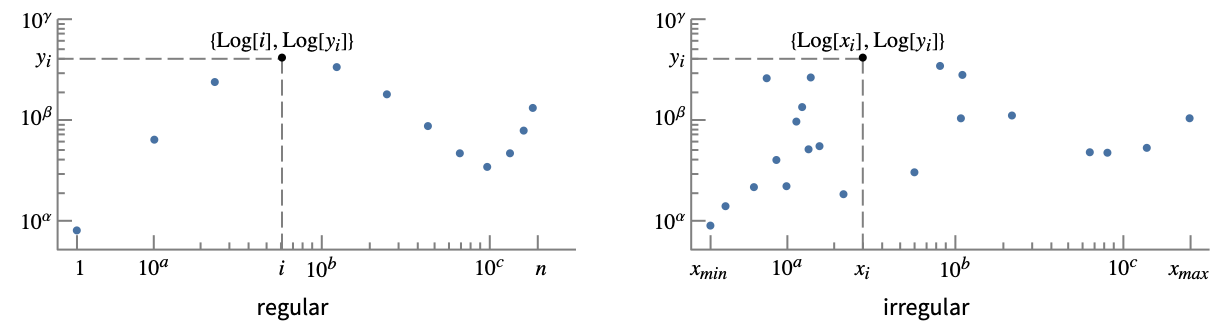
- ListLogLogPlot effectively plots points based on Log[xi] and Log[yi], but with tick marks indicating the unscaled values xi and yi.
- ListLogLogPlot makes power-law data appear as straight lines.
- Data values xi and yi can be given in the following forms:
-
xi a real-valued number Quantity[xi,unit] a quantity with a unit Around[xi,ei] value xi with uncertainty ei Interval[{xmin,xmax}] values between xmin and xmax - Values xi and yi that are not of the preceding form are taken to be missing and are not shown.
- The datai have the following forms and interpretations:
-
<"k1"y1,"k2"y2,…> values {y1,y2,…} <x1y1,x2y2,…> key-value pairs {{x1,y1},{x2,y2},…} {y1"lbl1",y2"lbl2",…}, {y1,y2,…}{"lbl1","lbl2",…} values {y1,y2,…} with labels {lbl1,lbl2,…} SparseArray values as a normal array TimeSeries, EventSeries time-value pairs QuantityArray magnitudes WeightedData unweighted values - ListLogLogPlot[Tabular[…]cspec] extracts and plots values from the tabular object using the column specification cspec.
- The following forms of column specifications cspec are allowed for plotting tabular data:
-
{colx,coly} plot column y against column x {{colx1,coly1},{colx2,coly2},…} plot column y1 against column x1, y2 against x2, … coly, {coly} plot column y as a sequence of values {{coly1},…,{colyi},…} plot columns y1, y2, … as sequences of values - The colx can also be Automatic, in which case, sequential values are generated using DataRange.
- ListLogLogPlot[TimeSeries[…]cspec] and ListLogLogPlot[EventSeries[…]cspec] extract and plot values from the time or event series using the component specification cspec.
- The following forms of component specifications cspec are allowed for plotting series data:
-
com plot component com against the timestamps {com1,com2,…} plot each component comi against the timestamps - The following wrappers w can be used for the datai:
-
Annotation[datai,label] provide an annotation for the data Button[datai,action] define an action to execute when the data is clicked Callout[datai,label] label the data with a callout Callout[datai,label,pos] place the callout at relative position pos EventHandler[datai,…] define a general event handler for the data Highlighted[fi,effect] dynamically highlight fi with an effect Highlighted[fi,Placed[effect,pos]] statically highlight fi with an effect at position pos Hyperlink[datai,uri] make the data a hyperlink Labeled[datai,label] label the data Labeled[datai,label,pos] place the label at relative position pos Legended[datai,label] identify the data in a legend PopupWindow[datai,cont] attach a popup window to the data StatusArea[datai,label] display in the status area on mouseover Style[datai,styles] show the data using the specified styles Tooltip[datai,label] attach a tooltip to the data Tooltip[datai] use data values as tooltips - Wrappers w can be applied at multiple levels:
-
{…,w[yi],…} wrap the value yi in data {…,w[{xi,yi}],…} wrap the point {xi,yi} w[datai] wrap the data w[{data1,…}] wrap a collection of datai w1[w2[…]] use nested wrappers - Callout, Labeled, and Placed can use the following positions pos:
-
Automatic automatically placed labels Above, Below, Before, After positions around the data x near the data at a position x Scaled[s] scaled position s along the data {s,Above},{s,Below},… relative position at position s along the data {pos,epos} epos in label placed at relative position pos of the data - ListLogLogPlot has the same options as Graphics, with the following additions and changes: [List of all options]
-
AspectRatio 1/GoldenRatio ratio of height to width Axes True whether to draw axes DataRange Automatic the range of x values to assume for data IntervalMarkers Automatic how to render uncertainty IntervalMarkersStyle Automatic style for uncertainty elements Filling None how to fill in stems for each point FillingStyle Automatic style to use for filling Joined Automatic whether to join points LabelingFunction Automatic how to label points LabelingSize Automatic maximum size of callouts and labels LabelingTarget Automatic how to determine automatic label positions PerformanceGoal $PerformanceGoal aspects of performance to try to optimize PlotFit None how to fit a curve to the points PlotFitElements Automatic fitted elements to show in the plot PlotHighlighting Automatic highlighting effect for data PlotInteractivity $PlotInteractivity whether to allow interactive elements PlotLabel None overall label for the plot PlotLabels None labels for data PlotLayout "Overlaid" how to position data PlotLegends None legends for data PlotMarkers None markers to use to indicate each point PlotRange Automatic range of values to include PlotRangeClipping True whether to clip at the plot range PlotStyle Automatic graphics directives to determine styles of points PlotTheme $PlotTheme overall theme for the plot ScalingFunctions None how to scale individual coordinates TargetUnits Automatic units to display in the plot - DataRange determines how values {y1,…,yn} are interpreted into {{x1,y1},…,{xn,yn}}. Possible settings include:
-
Automatic,All uniform from 1 to n {xmin,xmax} uniform from xmin to xmax - In general, a list of pairs {{x1,y1},{x2,y2},…} is interpreted as a list of points, but the setting DataRangeAll forces it to be interpreted as multiple datai {{y11,y12},{y21,y23},…}.
- LabelingFunction->f specifies that each point should have a label given by f[value,index,lbls], where value is the value associated with the point, index is its position in the data, and lbls is the list of relevant labels.
- Possible settings for PlotLayout that show multiple curves in a single plot panel include:
-

"Overlaid" show all the data overlapping 
"Stacked" accumulate the data 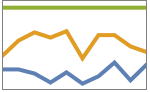
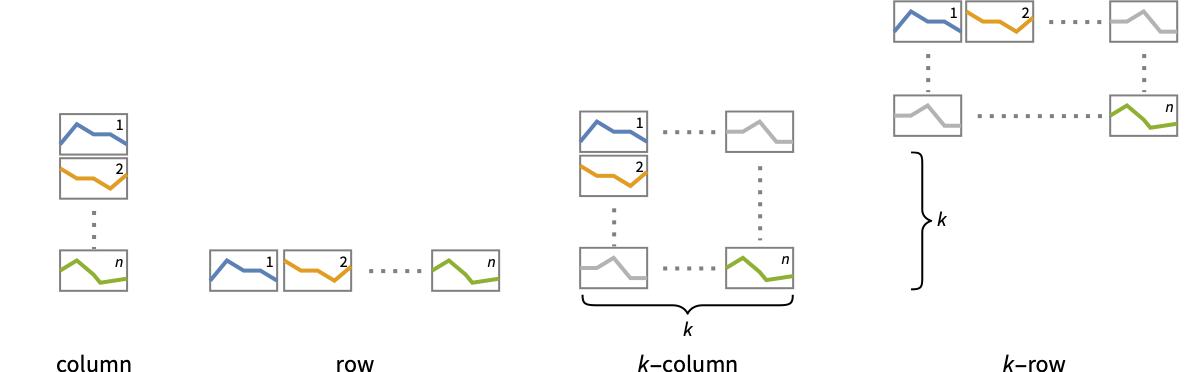
"Percentile" accumulate and normalize the data - Possible settings for PlotLayout that show single curves in multiple plot panels include:
-
"Column" use separate curves in a column of panels "Row" use separate curves in a row of panels {"Column",k},{"Row",k} use k columns or rows {"Column",UpTo[k]},{"Row",UpTo[k]} use at most k columns or rows - Typical settings for PlotLegends include:
-
None no legend Automatic automatically determine legend {lbl1,lbl2,…} use lbl1, lbl2, … as legend labels Placed[lspec,…] specify placement for legend - PlotStylesty specifies the styles to use for each curve. Possible settings include:
-
{sty1,sty2,…} sequence of styles for the datasets <"key"val,…> styling elements for different levels of data - The accepted keys are:
-
"Base" overall style for all the datai "Lists" list of styles styi for each datai - ColorData["DefaultPlotColors"] gives the default sequence of colors used by PlotStyle.
- Possible settings for ScalingFunctions include:
-
sy scale y axis {sx,sy} scale x and y axes - Common built-in scaling functions s include:
-
"Reverse" 
reverse the coordinate direction "Infinite" 
infinite scale - Scales for the x and y axes are applied after the default log scales have been applied.
- Possible highlighting effects for Highlighted and PlotHighlighting include:
-
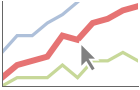
style highlight the indicated data 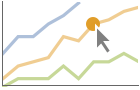
"Ball" highlight and label the indicated point in data 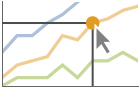
"Dropline" highlight and label the indicated point in data with droplines to the axes 
"XSlice" highlight and label all points along a vertical slice 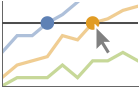
"YSlice" highlight and label all points along a horizontal slice 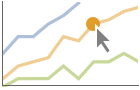
Placed[effect,pos] statically highlight the given position pos - Highlight position specifications pos include:
-
x, {x} effect at {x,y} with y chosen automatically {x,y} effect at {x,y} {pos1,pos2,…} multiple positions posi
List of all options
Examples
open all close allBasic Examples (5)
Powers show up as straight lines in a log-log plot:
ListLogLogPlot[Range[20] ^ 3]ListLogLogPlot[Range[20] ^ 3, Joined -> True]Use  ,
,  coordinates for the data:
ListLogLogPlot[Table[{n Log[n], Prime[n]}, {n, 20}]]Show multiple sets of data with a legend:
ListLogLogPlot[{Range[20], Sqrt[Range[20]], Log[Range[20]]}, Joined -> True, PlotLegends -> {"one", "two", "three"}]{data1, data2, data3} = Transpose[Table[{n, 2 ^ n, Fibonacci[n]}, {n, 10}]];ListLogLogPlot[{data1, data2, data3}, Joined -> True, PlotLabels -> {n, 2 ^ n, Fibonacci[n]}]ListLogLogPlot[Range[20] ^ 3, Filling -> Bottom]ListLogLogPlot[Range[20] ^ 3, Filling -> Bottom, Joined -> True]Scope (56)
General Data (10)
For regular data consisting of  values, the
  data range is taken to be integer values:
ListLogLogPlot[Range[40]]Provide an explicit  data range by using DataRange:
ListLogLogPlot[Range[40], DataRange -> {0, 1}]Plot multiple sets of regular data:
ListLogLogPlot[{Sqrt[Range[40]], Log[Range[40, 80]]}]For irregular data consisting of  ,
,  value pairs, the
  data range is inferred from data:
data = Last[Reap[NIntegrate[1 / x ^ 2, {x, 0.1, 2}, EvaluationMonitor :> Sow[{x, 1 / x ^ 2}]]]];ListLogLogPlot[data]Plot multiple sets of irregular data:
data1 = Table[{x, x ^ 3}, {x, RandomReal[20, 50]}];
data2 = Table[{x, x ^ 5}, {x, RandomReal[20, 250]}];ListLogLogPlot[{data1, data2}]Plot multiple sets of data, regular or irregular, using DataRange to map them to the same  range:
data1 = Table[x ^ 2, {x, 1, 10, 0.5}];
data2 = Table[{x, x ^ 5}, {x, RandomReal[10, 250]}];ListLogLogPlot[{data1, data2}, DataRange -> {1, 10}]Ranges where the data is nonpositive are excluded:
ListLogLogPlot[{1, 2, 3, 1 + I, 4, 5, 6, None, 7, 8, 9, Missing["NotAvailable"], 10, 11, 12}, Joined -> True, Mesh -> All]ListLogLogPlot[Sin[Range[0, 3Pi, 0.1]], Joined -> True, Mesh -> All]Use MaxPlotPoints to limit the number of points used:
Table[ListLogLogPlot[Table[{n, (Sin[3n] + 1)Gamma[n]}, {n, 0, 10, 0.01}], MaxPlotPoints -> mp, Joined -> True, Mesh -> All], {mp, {Infinity, 50, 30}}]PlotRange is selected automatically:
{ListLogLogPlot[{0, 1, 2, 3, 500, 5, 6, 7}, Joined -> True], ListLogLogPlot[{0, 1, 2, 3, 500, 5, 6, 7}, Joined -> True, PlotRange -> All]}Use PlotRange to focus on areas of interest:
{ListLogLogPlot[Table[{x, Exp[x] / Abs[x - 2]}, {x, 0, 5, 0.05}]], ListLogLogPlot[Table[{x, Exp[x] / Abs[x - 2]}, {x, 0, 5, 0.05}], PlotRange -> {10, 100}]}//QuietUse ScalingFunctions to reverse the direction of the y axis:
ListLogLogPlot[Table[Power[E, x], {x, 0, 50}], ScalingFunctions -> "Reverse"]Apply scaling functions to both sets of axes:
ListLogLogPlot[Table[Power[E, x], {x, 0, 50}], ScalingFunctions -> {"Reverse", "Reverse"}]Special Data (9)
Use Quantity to include units with the data:
ListLogLogPlot[Quantity[Sqrt[Range[10]], "Meters"], AxesLabel -> Automatic]Include different units for the  and
and  coordinates:
data = EntityValue[EntityClass["Element", All], {"AtomicMass", "MeltingPoint"}];ListLogLogPlot[data, AxesLabel -> Automatic]Plot data in a QuantityArray:
data = QuantityArray[EntityValue[EntityClass["Element", All], {"AtomicMass", "MeltingPoint"}]]ListLogLogPlot[data, AxesLabel -> Automatic]Specify the units used with TargetUnits:
ListLogLogPlot[data, TargetUnits -> {Automatic, "Kelvin"}, AxesLabel -> Automatic]ListLogLogPlot[Table[Around[RandomReal[100], RandomReal[1]], 20]]ListLogLogPlot[Table[Interval[RandomReal[{1, 100}, 2]], 20]]Specify strings to use as labels:
ListLogLogPlot[{2 -> "a", 3 -> "b", 5 -> "c", 7 -> "d", 11 -> "e", 13 -> "f", 17 -> "g"}]ListLogLogPlot[{2, 3, 5, 7, 11, 13, 17} -> {"a", "b", "c", "d", "e", "f", "g"}]Specify a location for labels:
ListLogLogPlot[{2, 3, 5, 7, 11, 13, 17} -> {"a", "b", "c", "d", "e", "f", "g"}, LabelingFunction -> Above]Numeric values in an Association are used as the  coordinates:
ListLogLogPlot[<|"a" -> 2, "b" -> 3, "c" -> 5, "d" -> 7, "e" -> 11, "f" -> 13|>]Numeric keys and values in an Association are used as the  and
and  coordinates:
ListLogLogPlot[<|2 -> 1, 3 -> 2, 5 -> 3, 7 -> 4, 11 -> 5, 13 -> 6|>]Plot TimeSeries directly:
data = CountryData["UnitedStates", {{"Population"}, {1988, 2013}}]ListLogLogPlot[data, AxesLabel -> Automatic]Plot data in a SparseArray:
ListLogLogPlot[SparseArray[Table[Prime[i] -> 1, {i, 25}]]]The weights in WeightedData are ignored:
ListLogLogPlot[WeightedData[{2, 3, 5, 7, 11, 13, 17, 19, 23, 29}, {1, 2, 3, 4, 5, 6, 7, 8, 9, 10}]]Tabular Data (3)
Get tabular data for countries around the world:
tab = EntityValue["Country", {"Name", "Continent", "Population", "GDP"}, "Tabular"]Plot the GDP of each country against its population:
ListLogLogPlot[tab -> {"Population", "GDP"}]Pivot the data so the GDP values are split per continent:
pivot = PivotToColumns[tab, "Continent" -> "GDP"]Compare the data for countries in North and South America:
ListLogLogPlot[pivot -> {{"Population", EntityClass["Country", "NorthAmerica"]}, {"Population", EntityClass["Country", "SouthAmerica"]}}, PlotLegends -> {"North America", "South America"}, Rule[...]]Plot all the data in TimeSeries or EventSeries:
ListLogLogPlot[TimeSeries[TimeEventSeries`TimestampData[Association["UniformlySpacedQ" -> False,
   "Timestamps" -> TabularColumn[Association[
      "Data" -> {7, {{NumericArray[{-248, 118, 298, 638, 865, 1006, 1216}, "Integer32"], {},
          None}}, None},  ...   "Data" -> {{32, 62, 112, 167, 179, 209, 214}, {}, None}, "ElementType" -> "Integer64"]],
         TabularColumn[Association["Data" -> {{30, 49, 81, 125, 142, 174, 177}, {}, None},
           "ElementType" -> "Integer64"]]}}]]]], Association[]]]
Plot a specific component of a TimeSeries or EventSeries:
trees = TimeSeries[TimeEventSeries`TimestampData[Association["UniformlySpacedQ" -> False,
   "Timestamps" -> TabularColumn[Association[
      "Data" -> {7, {{NumericArray[{-248, 118, 298, 638, 865, 1006, 1216}, "Integer32"], {},
          None}}, None},  ...   "Data" -> {{32, 62, 112, 167, 179, 209, 214}, {}, None}, "ElementType" -> "Integer64"]],
         TabularColumn[Association["Data" -> {{30, 49, 81, 125, 142, 174, 177}, {}, None},
"ElementType" -> "Integer64"]]}}]]]], Association[]];ListLogLogPlot[trees -> "tree 1"]ListLogLogPlot[trees -> {"tree 1", "tree 2"}]Data Wrappers (6)
Use wrappers on individual data, datasets, or collections of datasets:
{ListLogLogPlot[{{1, Style[2, Red], 3}, {4, 5, 6}}, PlotStyle -> PointSize[0.05]], ListLogLogPlot[{Style[{1, 2, 3}, Green], {4, 5, 6}}, PlotStyle -> PointSize[0.05]], ListLogLogPlot[Style[{{1, 2, 3}, {4, 5, 6}}, Blue], PlotStyle -> PointSize[0.05]]}{ListLogLogPlot[{{1, Style[2, Red], 3}, {4, 5, 6}}, PlotStyle -> PointSize[0.05]], ListLogLogPlot[{Style[{1, Style[2, Red], 3}, Green], {4, 5, 6}}, PlotStyle -> PointSize[0.05]], ListLogLogPlot[Style[{Style[{1, Style[2, Red], 3}, Green], {4, 5, 6}}, Blue], PlotStyle -> PointSize[0.05]]}Use the value of each point as a tooltip:
ListLogLogPlot[Tooltip[Prime[Range[100]]]]Use a specific label for all the points:
ListLogLogPlot[Tooltip[Prime[Range[100]], "primes"]]Labels points with automatically positioned text:
ListLogLogPlot[Table[Labeled[RandomReal[1, 2], i], {i, 20}], PlotStyle -> PointSize[Medium], ImageSize -> 300]Use PopupWindow to provide additional drilldown information:
ListLogLogPlot[{1, PopupWindow[2, DateListPlot[FinancialData["IBM", "Jan. 1, 2004"]]], 3}, PlotStyle -> PointSize[0.05]]Button can be used to trigger any action:
ListLogLogPlot[{1, Button[2, Speak[2]], 3}, PlotStyle -> PointSize[0.05]]Labeling and Legending (16)
Label points with automatically positioned text:
ListLogLogPlot[Table[Labeled[RandomReal[1, 2], i], {i, 20}]]Place the labels relative to the points:
Table[ListLogLogPlot[Table[Labeled[RandomReal[1, 2], i, p], {i, 5}], PlotLabel -> p], {p, {Above, Below, Before, After}}]Label data with Labeled:
data = Table[Table[{x, f}, {x, 0, 2Pi, 0.1}], {f, {Exp[x], Log[2x]}}];ListLogLogPlot[MapThread[Labeled[#1, #2]&, {data, {Exp[x], Log[2x]}}]]Label data with PlotLabels:
data = Table[Table[{x, f}, {x, 0, 2Pi, 0.1}], {f, {Exp[x], Exp[x + 2]}}];ListLogLogPlot[data, PlotLabels -> {Exp[x], Exp[x + 2]}]Place the label near the points at an  value:
ListLogLogPlot[Labeled[Table[{x, Exp[x]}, {x, .1, 2Pi, 0.1}], "exp(x)", 3]]ListLogLogPlot[Labeled[Table[{x, Log[x]}, {x, 1.1, 2Pi, 0.1}], "log(x)", Scaled[0.25]]]Specify the text position relative to the point:
ListLogLogPlot[Labeled[Table[{x, Log[x]}, {x, 1.1, 2Pi, 0.1}], Log[x], {Scaled[0.25], Above}]]Label data automatically with Callout:
ListLogLogPlot[{Callout[Table[PartitionsQ[n], {n, 18}], PartitionsQ[n]], Callout[Table[n, {n, 18}], n]}]Place a label with a specific location:
ListLogLogPlot[Callout[Table[n ^ Sin[n], {n, 1, 10, 0.25}], "label", Above]]ListLogLogPlot[Callout[Table[n ^ Sin[n], {n, 1, 10, 0.25}], "label", 5]]Specify label names with LabelingFunction:
ListLogLogPlot[Prime[Range[10]], LabelingFunction -> (#1 &)]Specify the maximum size of labels:
data = Table[Labeled[Prime[i], RandomWord[]], {i, 10}];ListLogLogPlot[data, LabelingSize -> 30]ListLogLogPlot[data, LabelingSize -> Full]For dense sets of points, some labels may be turned into tooltips by default:
data = Table[Callout[RandomReal[1, 2], i], {i, 100}];ListLogLogPlot[data]Increasing the size of the plot will show more labels:
ListLogLogPlot[data, ImageSize -> 400]Include legends for each curve:
data = Table[Table[{x, f}, {x, 0, 2Pi, 0.1}], {f, {Log[x], Exp[2x]}}];ListLogLogPlot[data, PlotLegends -> {Log[x], Exp[2x]}]Use Legended to provide a legend for a specific dataset:
upper = RandomReal[{1.5, 2}, 50];
lower = RandomReal[0.5, 50];ListLogLogPlot[{lower, Legended[Mean[{lower, upper}], "average"], upper}]Use Placed to change the legend location:
ListLogLogPlot[{lower, Legended[Mean[{lower, upper}], Placed["average", Below]], upper}]Use association keys as labels:
ListLogLogPlot[<|"fibonacci" -> Fibonacci[Range[10]], "primes" -> Prime[Range[10]]|>, PlotLabels -> Automatic, PlotLegends -> None]Plots usually have interactive callouts showing the coordinates when you mouse over them:
ListLogLogPlot[{IconizedObject[«Fibonacci»], IconizedObject[«Primes»]}]Including specific wrappers or interactions, such as tooltips, turns off the interactive features:
ListLogLogPlot[Callout[IconizedObject[«Fibonacci»], "hello", 10]]Choose from multiple interactive highlighting effects:
{ListLogLogPlot[{IconizedObject[«Fibonacci»], IconizedObject[«Primes»]}, PlotHighlighting -> "Dropline"], ListLogLogPlot[{IconizedObject[«Fibonacci»], IconizedObject[«Primes»]}, PlotHighlighting -> "XSlice"]}Use Highlighted to emphasize specific points in a plot:
ListLogLogPlot[Highlighted[IconizedObject[«Fibonacci»], Placed["Ball", 7]]]ListLogLogPlot[Highlighted[IconizedObject[«Fibonacci»], Placed["Ball", {{3}, {8}}]]]Presentation (12)
Multiple datasets are automatically colored to be distinct:
data = Table[Table[{x, f}, {x, 0, 10, 0.1}], {f, {Exp[x], Gamma[x]}}];ListLogLogPlot[data]Provide explicit styling to different sets:
data = Table[Table[{x, f}, {x, 0, 10, 0.1}], {f, {Exp[x], Gamma[x]}}];ListLogLogPlot[data, PlotStyle -> {Blue, Red}]Include legends for each curve:
data = Table[Table[{x, f}, {x, 0, 10, 0.1}], {f, {Exp[x], Gamma[x]}}];ListLogLogPlot[data, PlotLegends -> {Exp[x], Gamma[x]}]ListLogLogPlot[Table[{k, Binomial[30, k]}, {k, 0, 31}], AxesLabel -> {k, None}, PlotLabel -> Binomial[30, k], PlotStyle -> Directive[PointSize[Medium], Purple]]Provide an interactive Tooltip for the data:
ListLogLogPlot[Table[Tooltip[x, If[PrimeQ[x], Row[{"prime: ", x}], x]], {x, 1, 25}], PlotStyle -> Directive[PointSize[Medium], Orange]]data = Table[Tooltip[Table[{x, f}, {x, 0, 10, 0.1}], TraditionalForm[f]], {f, {Exp[x], Gamma[x]}}];ListLogLogPlot[data, Joined -> True, PlotStyle -> Thick]data = Table[Table[{x, f}, {x, 0, 10, 0.1}], {f, {Exp[x], Gamma[x]}}];ListLogLogPlot[data, Filling -> {1 -> {2}}, FillingStyle -> {Red, Blue}]Use shapes to distinguish different datasets:
ListLogLogPlot[{{1, 2, 3, 5, 8}, {2, 3, 6, 9, 10}, {4, 5, 10, 14, 16}}, PlotMarkers -> Automatic]Use labels to distinguish different datasets:
ListLogLogPlot[{{1, 2, 3, 5, 8}, {2, 3, 6, 9, 10}, {4, 5, 10, 14, 16}}, PlotMarkers -> {"1", "2", "3"}]Use Joined to connect datasets with lines:
ListLogLogPlot[{1, 2, 4, 7, 3, 5, 8, 10, 9}, Joined -> True, PlotStyle -> Orange]Use InterpolationOrder to smooth joined data:
Table[ListLogLogPlot[{2, 4, 16, 128, 8, 32, 256, 1024, 512}, Joined -> True, InterpolationOrder -> io, PlotStyle -> Dashed], {io, {0, 1, 2, 3}}]Use a theme with detailed frame ticks and grid lines:
ListLogLogPlot[Table[Table[{x, f}, {x, 0, 10, 0.1}], {f, {Exp[x], Gamma[x]}}], PlotTheme -> "Detailed"]Use a theme with a dark background and vibrant colors:
ListLogLogPlot[Table[Table[{x, f}, {x, 0, 10, 0.1}], {f, {Exp[x], Gamma[x]}}], PlotTheme -> "Marketing"]Plot the data in a stacked layout:
data = {{10, 9, 4, 3, 5, 3, 5, 5, 2, 6}, {2, 10, 5, 6, 9, 4, 9, 3, 7, 2}, {7, 8, 3, 4, 4, 2, 6, 3, 8, 7}};ListLogLogPlot[data, PlotLayout -> "Stacked", Joined -> True]Plot the data as percentiles of the total of the values:
ListLogLogPlot[data, PlotLayout -> "Percentile", Joined -> True]Options (143)
ClippingStyle (6)
ClippingStyle only applies to Joined datasets:
data = Table[{x, Tan[x]}, {x, -2 Pi, 2 Pi, .1}];//Quiet{ListLogLogPlot[data, ClippingStyle -> Red, PlotRange -> {{.1, 3}, {.01, 1}}], ListLogLogPlot[data, ClippingStyle -> Red, Joined -> True, PlotRange -> {{.1, 3}, {.01, 1}}]}Omit clipped regions of the plot:
data = Table[{x, Tan[x]}, {x, -2 Pi, 2 Pi, .1}];//QuietListLogLogPlot[data, ClippingStyle -> None, Joined -> True, PlotRange -> {{.01, 3}, All}]Show clipped regions like the rest of the curve:
data = Table[{x, Tan[x]}, {x, -2 Pi, 2 Pi, .1}];//QuietListLogLogPlot[data, ClippingStyle -> Automatic, PlotStyle -> Thick, Joined -> True, PlotRange -> {All, {.5, 1}}]Show clipped regions with red lines:
data = Table[{x, Tan[x]}, {x, -2 Pi, 2 Pi, .1}];//QuietListLogLogPlot[data, ClippingStyle -> Red, Joined -> True, PlotRange -> {{1.2, 1.5}, {.1, 5}}]Show clipped regions as red at the bottom and thick at the top:
data = Table[{x, Tan[x]}, {x, -2 Pi, 5Pi, .1}];//QuietListLogLogPlot[data, ClippingStyle -> {Red, Thick}, Joined -> True, PlotRange -> {All, {.1, 1}}, AxesOrigin -> {.1, .3}]Show clipped regions as red and thick:
data = Table[{x, Tan[x]}, {x, -2 Pi, 5Pi, .1}];//QuietListLogLogPlot[data, ClippingStyle -> Directive[Red, Thick], Joined -> True, PlotRange -> {All, {.1, 1}}, AxesOrigin -> {.1, .3}]ColorFunction (6)
ColorFunction only applies to Joined datasets:
{ListLogLogPlot[Table[{x, Gamma[x]}, {x, 1, 7, 0.1}], ColorFunction -> "Rainbow"], ListLogLogPlot[Table[{x, Gamma[x]}, {x, 1, 7, 0.1}], ColorFunction -> "Rainbow", Joined -> True]}Color by scaled  and
and  coordinates:
Table[ListLogLogPlot[Table[{x, Gamma[x]}, {x, 1, 7, 0.1}], Joined -> True, ColorFunction -> Function[{x, y}, Evaluate[f]], PlotLabel -> f, PlotStyle -> Thick], {f, {Hue[x], Hue[y]}}]Color with a named color scheme:
ListLogLogPlot[Table[{x, Gamma[x]}, {x, 1, 7, 0.1}], Joined -> True, ColorFunction -> "DarkRainbow"]Fill with the color used for the curve:
ListLogLogPlot[Table[{x, Gamma[x]}, {x, 1, 7, 0.1}], Joined -> True, ColorFunction -> Function[{x, y}, Hue[x]], Filling -> Axis]ColorFunction has higher priority than PlotStyle for coloring the curve:
ListLogLogPlot[Table[{x, Gamma[x]}, {x, 1, 7, 0.1}], Joined -> True, ColorFunction -> "DarkRainbow", PlotStyle -> Directive[Red, Thick]]Use Automatic in MeshShading to use ColorFunction:
ListLogLogPlot[Table[{x, Gamma[x]}, {x, 1, 7, 0.1}], Joined -> True, ColorFunction -> "Rainbow", PlotStyle -> Directive[Red, Thick], Mesh -> 10, MeshShading -> {Automatic, StandardGray}, MeshStyle -> None]ColorFunctionScaling (3)
ColorFunctionScaling only applies to Joined datasets:
{ListLogLogPlot[Range[10], ColorFunction -> "Rainbow", ColorFunctionScaling -> True], ListLogLogPlot[Range[10], Joined -> True, ColorFunction -> "Rainbow", ColorFunctionScaling -> True]}Use no argument scaling on the left and automatic scaling on the right:
Table[ListLogLogPlot[Table[Gamma[x], {x, 1, 7}], PlotStyle -> Thick, ColorFunction -> Function[{x, y}, Hue[y]], ColorFunctionScaling -> cf, Joined -> True], {cf, {False, True}}]Scaling is done on a linear scale in the original coordinates:
Table[ListLogLogPlot[Table[Exp[t], {t, 0, 2 ^ i, 0.1}], Joined -> True, PlotStyle -> Thick, ColorFunction -> Function[{x, y}, Hue[y]]], {i, {0, 2, 4}}]Use a color function that is red at powers of 10:
ListLogLogPlot[Table[Gamma[x], {x, 1, 7, 0.1}], Joined -> True, ColorFunction -> Function[{x, y}, Hue[Log[10, y]]], PlotStyle -> Thick, ColorFunctionScaling -> False]DataRange (5)
Lists of height values are displayed against the number of elements:
ListLogLogPlot[Table[Exp[x], {x, 0, 3, 0.1}]]Rescale to the sampling space:
ListLogLogPlot[Table[Exp[x], {x, 0, 3, 0.1}], DataRange -> {0, 3}]Each dataset is scaled to the same domain:
ListLogLogPlot[{Factorial[Range[30]], Exp[Range[10, 50]]}, DataRange -> {1, 5}]Pairs are interpreted as  ,
,  coordinates:
ListLogLogPlot[Table[{i + 10, i!}, {i, 25}], AxesOrigin -> {1, 0}]Specifying DataRange in this case has no effect, since  values are part of the data:
ListLogLogPlot[Table[{i + 10, i!}, {i, 25}], AxesOrigin -> {1, 0}, DataRange -> {1, 10}]Force interpretation as multiple datasets:
ListLogLogPlot[{{1, 4}, {2, 2}, {3, 3}}, DataRange -> All, AxesOrigin -> {0, 0}, Joined -> True]Filling (8)
Use symbolic or explicit values for "stem" filling:
Table[ListLogLogPlot[Table[Prime[n], {n, 30}], Filling -> c], {c, {Top, Bottom, Axis, Prime[15]}}]Fill between corresponding points in two datasets:
ListLogLogPlot[{Range[20], Table[Prime[n], {n, 20}]}, Filling -> {1 -> {2}}]Fill between datasets using a particular style:
ListLogLogPlot[{Range[20], Table[Prime[n], {n, 20}]}, Filling -> {1 -> {{2}, Directive[Orange, Dashed]}}]Fill between datasets 1 and 2; use red when 1 is less than 2 and blue otherwise:
data1 = Factorial[Range[30]];
data2 = Exp[Range[30] + 15];ListLogLogPlot[{data1, data2}, Filling -> {1 -> {{2}, {Red, Blue}}}]Fill to the axis for irregularly sampled data:
data = Last[Reap[Plot[Abs[Tan[x]], {x, 0, 10}, EvaluationMonitor :> Sow[{x, Abs[Tan[x]]}]]]];ListLogLogPlot[data, Filling -> Axis]Use several irregular datasets, filling between them:
data1 = First@Last[Reap[Plot[Abs[Tan[x]], {x, 0, 2Pi}, EvaluationMonitor :> Sow[{x, Abs[Tan[x]]}]]]];
data2 = First@Last[Reap[Plot[Abs[Cot[x]], {x, 0, 2Pi}, EvaluationMonitor :> Sow[{x, Abs[Cot[x]]}]]]];ListLogLogPlot[{Sort@data1, Sort@data2}, Filling -> {1 -> {2}}]Joined datasets fill with solid areas:
ListLogLogPlot[{Range[20], Table[{n + 1 / 2, Prime[n]}, {n, 20}]}, Filling -> {1 -> {2}}, Joined -> True]The type of filling depends on whether the first set is joined:
Table[ListLogLogPlot[{Range[20], Range[20] / 2}, Joined -> {True, False}, Filling -> f, PlotLabel -> f], {f, {1 -> {2}, 2 -> {1}}}]FillingStyle (4)
ListLogLogPlot[Table[Prime[n], {n, 20}], Filling -> Axis, FillingStyle -> Blue]Fill with dashed magenta "stems":
ListLogLogPlot[Table[Prime[n], {n, 20}], Filling -> Axis, FillingStyle -> Directive[Magenta, Dashed]]Fill with red below  and blue above:
ListLogLogPlot[Table[{x, Gamma[x]}, {x, 0, 10, 0.2}], Filling -> 100, FillingStyle -> {Red, Blue}]Filling is solid when Joined->True:
ListLogLogPlot[Table[Prime[n], {n, 20}], Filling -> Axis, Joined -> True]InterpolationOrder (5)
Lines created with Joined can be interpolated:
ListLogLogPlot[{{1, 4, 2, 3, 10, 8, 2}}, Joined -> True, InterpolationOrder -> 2]By default, linear interpolation is used:
ListLogLogPlot[{{1, 4, 2, 3, 10, 8, 2}}, Joined -> True, InterpolationOrder -> None, Mesh -> Full]Use zero-order or piecewise-constant interpolation:
ListLogLogPlot[{{1, 4, 2, 3, 10, 8, 2}}, Joined -> True, InterpolationOrder -> 0, Mesh -> Full]Use third-order spline interpolation:
ListLogLogPlot[{{1, 4, 2, 3, 10, 8, 2}}, Joined -> True, InterpolationOrder -> 3, Mesh -> Full]Table[ListLogLogPlot[{{1, 4, 2, 3, 10, 8, 2}}, Joined -> True, InterpolationOrder -> i, Mesh -> Full, PlotLabel -> i], {i, 0, 5}]IntervalMarkers (3)
By default, uncertainties are capped:
ListLogLogPlot[Table[Around[RandomReal[{50, 100}], 10], 10]]Use bars to denote uncertainties without caps:
ListLogLogPlot[Table[Around[RandomReal[{50, 100}], 10], 10], IntervalMarkers -> "Bars"]Use bands to represent uncertainties:
ListLogLogPlot[Table[Around[RandomReal[{0.5, 1}], .1], 10], IntervalMarkers -> "Bands", Joined -> True]IntervalMarkersStyle (2)
Uncertainties automatically inherit the plot style:
ListLogLogPlot[{Table[Around[RandomReal[{50, 100}], 10], 10], Table[Around[RandomReal[{150, 200}], 10], 10]}, PlotMarkers -> Automatic]Specify the style for uncertainties:
ListLogLogPlot[{Table[Around[RandomReal[{50, 100}], 10], 10], Table[Around[RandomReal[{150, 200}], 10], 10]}, IntervalMarkersStyle -> Gray, PlotMarkers -> Automatic]Joined (6)
ListLogLogPlot[Table[Prime[n], {n, 20}], Joined -> True]Join the first dataset with a line but use points for the second dataset:
ListLogLogPlot[{Range[20], Table[Prime[n], {n, 20}]}, Joined -> {True, False}]Join the dataset with a line and show the original points:
ListLogLogPlot[Table[Prime[n], {n, 20}], Joined -> True, Mesh -> All]TimeSeries is shown as continuous lines:
ListLogLogPlot[TimeSeries[TimeEventSeries`TimestampData[Association["UniformlySpacedQ" -> False,
   "Timestamps" -> TabularColumn[Association[
      "Data" -> {12, {{NumericArray[{20089, 20120, 20148, 20179, 20209, 20240, 20270, 20301, 20332,
           20362,  ...       146, 166}, {}, None}, "ElementType" -> "Integer64"]],
         TabularColumn[Association["Data" -> {{204, 188, 235, 227, 234, 264, 302, 293, 259, 229,
              203, 229}, {}, None}, "ElementType" -> "Integer64"]]}}]]]], Association[]]]
EventSeries is shown as discrete points:
ListLogLogPlot[EventSeries[TimeEventSeries`TimestampData[Association["UniformlySpacedQ" -> False,
   "Timestamps" -> TabularColumn[Association[
      "Data" -> {12, {{NumericArray[{20089, 20120, 20148, 20179, 20209, 20240, 20270, 20301, 20332,
           20362, ...       146, 166}, {}, None}, "ElementType" -> "Integer64"]],
         TabularColumn[Association["Data" -> {{204, 188, 235, 227, 234, 264, 302, 293, 259, 229,
              203, 229}, {}, None}, "ElementType" -> "Integer64"]]}}]]]], Association[]]]
The type of filling depends on whether the set is joined:
Table[ListLogLogPlot[{Range[20], Range[20] / 2}, Joined -> {True, False}, Filling -> f, PlotLabel -> f], {f, {1 -> {2}, 2 -> {1}}}]LabelingFunction (6)
By default, points are automatically labeled with strings:
ListLogLogPlot[{1, 1, 2, 3, 5, 8} -> {"a", "b", "c", "d", "e", "f"}]Use LabelingFunction->None to suppress the labels:
ListLogLogPlot[{1, 1, 2, 3, 5, 8} -> {"a", "b", "c", "d", "e", "f"}, LabelingFunction -> None]Put the labels above the points:
ListLogLogPlot[{1, 1, 2, 3, 5, 8} -> {"a", "b", "c", "d", "e", "f"}, LabelingFunction -> Above]ListLogLogPlot[{1, 1, 2, 3, 5, 8} -> {"a", "b", "c", "d", "e", "f"}, LabelingFunction -> Tooltip]Use callouts to label the points:
ListLogLogPlot[{1, 1, 2, 3, 5, 8} -> {"a", "b", "c", "d", "e", "f"}, LabelingFunction -> Callout[Automatic, Automatic]]Label the points with their values:
ListLogLogPlot[{1, 1, 2, 3, 5, 8} -> {"a", "b", "c", "d", "e", "f"}, LabelingFunction -> (#1&)]Label the points with their indices:
ListLogLogPlot[{1, 1, 2, 3, 5, 8} -> {"a", "b", "c", "d", "e", "f"}, LabelingFunction -> (#2&)]LabelingSize (4)
Textual labels are shown at their actual sizes:
ListLogLogPlot[{1, 1, 2, 3, 5, 8} -> {"healthfulness", "obstreperous", "spectrogram", "vestige", "coinage", "limey"}, ImageSize -> Medium]Image labels are automatically resized:
ListLogLogPlot[{1, 1, 2, 3, 5, 8} -> {[image], [image], [image], [image], [image], [image]}, ImageSize -> Medium]Specify a maximum size for textual labels:
ListLogLogPlot[{1, 1, 2, 3, 5, 8} -> {"healthfulness", "obstreperous", "spectrogram", "vestige", "coinage", "limey"}, ImageSize -> Medium, LabelingSize -> 30]Specify a maximum size for image labels:
ListLogLogPlot[{1, 1, 2, 3, 5, 8} -> {[image], [image], [image], [image], [image], [image]}, ImageSize -> Medium, LabelingSize -> 20]Show image labels at their natural sizes:
ListLogLogPlot[{1, 1, 2, 3, 5, 8} -> {[image], [image], [image], [image], [image], [image]}, ImageSize -> Medium, LabelingSize -> Full]LabelingTarget (7)
Labels are automatically placed to maximize readability:
ListLogLogPlot[IconizedObject[«data»]]ListLogLogPlot[IconizedObject[«data»], LabelingTarget -> All]Use a denser layout for the labels:
ListLogLogPlot[IconizedObject[«data»], LabelingTarget -> "Dense"]Show the quarter of the labels that are easiest to read:
ListLogLogPlot[IconizedObject[«data»], LabelingTarget -> 0.25]Only allow labels that are orthogonal to the points:
ListLogLogPlot[IconizedObject[«data»], LabelingTarget -> <|"AllowedLabelingPositions" -> "Sides"|>]Only allow labels that are diagonal to the points:
ListLogLogPlot[IconizedObject[«data»], LabelingTarget -> <|"AllowedLabelingPositions" -> "Corners"|>]Restrict labels to be above or to the right of the points:
ListLogLogPlot[IconizedObject[«data»], LabelingTarget -> <|"AllowedLabelingPositions" -> {"Right", "Top"}|>]Allow labels to obscure other points:
ListLogLogPlot[IconizedObject[«data»], LabelingTarget -> <|"AllowedOverlaps" -> {"Points"}|>]Allow labels to be clipped by the edges of the plot:
ListLogLogPlot[IconizedObject[«data»], LabelingTarget -> <|"AllowLabelClipping" -> True|>]MaxPlotPoints (3)
All points are included by default:
ListLogLogPlot[Gamma[Range[0, 10, 0.05]], Joined -> True, Mesh -> All]Uniformly spaced data is downsampled:
Table[ListLogLogPlot[Gamma[Range[0, 10, 0.05]], MaxPlotPoints -> mp, Joined -> True, Mesh -> All], {mp, {Infinity, 50, 30}}]Nonuniform data is topologically subsampled to preserve features:
Table[ListLogLogPlot[Table[{n, (Sin[3n] + 1)Gamma[n]}, {n, 0, 10, 0.01}], MaxPlotPoints -> mp, Joined -> True, Mesh -> All], {mp, {Infinity, 50, 30}}]Mesh (6)
Mesh only applies to Joined datasets:
{ListLogLogPlot[Table[Gamma[x], {x, 8}], Mesh -> 10], ListLogLogPlot[Table[Gamma[x], {x, 8}], Mesh -> 10, Joined -> True]}The initial and final sampling meshes are typically the same:
{ListLogLogPlot[Table[Gamma[x], {x, 8}], Mesh -> Full, Joined -> True], ListLogLogPlot[Table[Gamma[x], {x, 8}], Mesh -> All, Joined -> True]}Interpolated data may introduce points:
{ListLogLogPlot[Table[Gamma[x], {x, 8}], Mesh -> Full, InterpolationOrder -> 2, Joined -> True], ListLogLogPlot[Table[Gamma[x], {x, 8}], Mesh -> All, InterpolationOrder -> 2, Joined -> True]}Use 20 mesh levels evenly spaced in the  direction:
ListLogLogPlot[Table[Gamma[x], {x, 8}], Mesh -> 20, Joined -> True]Use an explicit list of values for the mesh in the  direction:
ListLogLogPlot[Table[{x, Gamma[x]}, {x, 0., 10, 0.1}], Mesh -> {Range[10]}, MeshStyle -> PointSize[Medium], Joined -> True]Use explicit styles at specific points:
ListLogLogPlot[Table[{x, Gamma[x]}, {x, 0, 10}], Mesh -> {Table[{x, Directive[Hue[x / (10)], PointSize[Medium]]}, {x, 1, 10, 1}]}, Joined -> True]MeshFunctions (2)
MeshFunctions only applies to Joined datasets:
{ListLogLogPlot[Table[Binomial[20, k], {k, 0, 20}], Mesh -> 10, MeshFunctions -> {#1&}], ListLogLogPlot[Table[Binomial[20, k], {k, 0, 20}], Mesh -> 10, MeshFunctions -> {#1&}, Joined -> True]}Use a mesh evenly spaced in the  direction and unscaled in the
  direction:
Table[ListLogLogPlot[Table[Binomial[20, k], {k, 0, 20}], MeshFunctions -> {Function[{x, y}, Evaluate[f]]}, Mesh -> 9, PlotLabel -> f, Joined -> True], {f, {x, y}}]MeshShading (7)
MeshShading only applies to Joined datasets:
{ListLogLogPlot[Table[Binomial[20, k], {k, 0, 20}], Mesh -> 10, MeshShading -> {Red, Blue}], ListLogLogPlot[Table[Binomial[20, k], {k, 0, 20}], Mesh -> 10, MeshShading -> {Red, Blue}, Joined -> True]}Alternate red and blue segments of equal width in the  direction:
ListLogLogPlot[Table[Binomial[20, k], {k, 0, 20}], Mesh -> 10, MeshFunctions -> {#1&}, MeshShading -> {Red, Blue}, Joined -> True]Use None to remove segments:
ListLogLogPlot[Table[Binomial[20, k], {k, 0, 20}], Mesh -> 10, MeshFunctions -> {#1&}, MeshShading -> {Red, None}, Joined -> True]MeshShading can be used with PlotStyle:
ListLogLogPlot[Table[Binomial[20, k], {k, 0, 20}], Mesh -> 10, PlotStyle -> Thick, MeshFunctions -> {#1&}, MeshShading -> {Red, Blue}, Joined -> True]MeshShading has higher priority than PlotStyle for styling the curve:
ListLogLogPlot[Table[Binomial[20, k], {k, 0, 20}], Mesh -> 10, PlotStyle -> Green, MeshFunctions -> {#1&}, MeshShading -> {Red, Blue}, Joined -> True]Use PlotStyle for some segments by setting MeshShading to Automatic:
ListLogLogPlot[Table[Binomial[20, k], {k, 0, 20}], Mesh -> 10, PlotStyle -> Directive[Thick, Yellow], MeshFunctions -> {#1&}, MeshShading -> {Red, Automatic}, Joined -> True]MeshShading can be used with ColorFunction and has higher priority:
ListLogLogPlot[Table[Binomial[20, k], {k, 0, 20}], Mesh -> 10, PlotStyle -> Thick, MeshFunctions -> {#1&}, MeshShading -> {StandardGray, Automatic},
	ColorFunction -> Function[{x, y}, Hue[x]], Joined -> True]
MeshStyle (5)
MeshStyle only applies to Joined datasets:
{ListLogLogPlot[Table[Binomial[20, k], {k, 0, 20}], Mesh -> 10, MeshStyle -> Red], ListLogLogPlot[Table[Binomial[20, k], {k, 0, 20}], Mesh -> 10, MeshStyle -> Red, Joined -> True]}Color the mesh the same color as the plot:
ListLogLogPlot[Table[Binomial[20, k], {k, 0, 20}], Mesh -> 10, MeshStyle -> Automatic, Joined -> True]Use a red mesh in the  direction:
ListLogLogPlot[Table[Binomial[20, k], {k, 0, 20}], Mesh -> 10, MeshStyle -> Red, Joined -> True]Use a red mesh in the  direction and a blue mesh in the
  direction:
ListLogLogPlot[Table[Binomial[20, k], {k, 0, 20}], Mesh -> 10, MeshStyle -> {Red, Blue}, MeshFunctions -> {#1&, #2&}, Joined -> True]Use big red mesh points in the  direction:
ListLogLogPlot[Table[Binomial[20, k], {k, 0, 20}], Mesh -> 10, MeshStyle -> Directive[PointSize[Large], Red], Joined -> True]PlotFit (4)
Automatically fit a model to the data:
ListLogLogPlot[ResourceData["Sample Tabular Data: Car Models"] -> {"weight", "mpg"}, PlotFit -> Automatic]Fit a straight line to the data:
ListLogLogPlot[ResourceData["Sample Tabular Data: Car Models"] -> {"weight", "mpg"}, PlotFit -> "Linear"]Fit a quadratic curve to the data:
ListLogLogPlot[ResourceData["Sample Tabular Data: Car Models"] -> {"weight", "mpg"}, PlotFit -> "Quadratic"]Use LogModel to fit the data:
ListLogLogPlot[ResourceData["Sample Tabular Data: Car Models"] -> {"weight", "mpg"}, PlotFit -> LogModel[]]PlotFitElements (3)
By default, the fitted model is shown with the data points:
ListLogLogPlot[ResourceData["Sample Tabular Data: Car Models"] -> {"weight", "mpg"}, PlotFit -> Automatic]Plot confidence bands for the data, with a default confidence level of 0.95:
ListLogLogPlot[ResourceData["Sample Tabular Data: Car Models"] -> {"weight", "mpg"}, PlotFit -> Automatic, PlotFitElements -> "BandCurves"]Use a confidence level of 0.5 for the bands:
ListLogLogPlot[ResourceData["Sample Tabular Data: Car Models"] -> {"weight", "mpg"}, PlotFit -> Automatic, PlotFitElements -> {"BandCurves", <|"ConfidenceLevel" -> 0.5|>}]Show residual lines from the data points to the fitted curve:
ListLogLogPlot[ResourceData["Sample Tabular Data: Car Models"] -> {"weight", "mpg"}, PlotFit -> Automatic, PlotFitElements -> "Residuals"]Combine the original points with gray residual lines:
ListLogLogPlot[ResourceData["Sample Tabular Data: Car Models"] -> {"weight", "mpg"}, PlotFit -> Automatic, PlotFitElements -> {"DataPoints", {"Residuals", <|"Style" -> StandardRed|>}}]PlotHighlighting (9)
Plots have interactive coordinate callouts with the default setting PlotHighlightingAutomatic:
ListLogLogPlot[{IconizedObject[«Fibonacci»], IconizedObject[«Primes»]}]Use PlotHighlightingNone to disable the highlighting for the entire plot:
ListLogLogPlot[{IconizedObject[«primes»], IconizedObject[«squares»]}, PlotHighlighting -> None]Use Highlighted[…,None] to disable highlighting for a single set:
ListLogLogPlot[{IconizedObject[«primes»], Highlighted[IconizedObject[«squares»], None]}]Move the mouse over a set of points to highlight it using arbitrary graphics directives:
ListLogLogPlot[{IconizedObject[«primes»], IconizedObject[«squares»]}, PlotHighlighting -> Directive[Red, AbsolutePointSize[10], DropShadowing[]]]Move the mouse over the points to highlight them with balls and labels:
ListLogLogPlot[IconizedObject[«primes»], PlotHighlighting -> "Dropline"]ListLogLogPlot[Highlighted[IconizedObject[«primes»], Placed["Dropline", {{7}, {15}}]]]Move the mouse over the curve to highlight it with a label and droplines to the axes:
ListLogLogPlot[IconizedObject[«primes»], PlotHighlighting -> "Dropline"]Use a ball and label to highlight a specific point in the plot:
ListLogLogPlot[Highlighted[IconizedObject[«primes»], Placed["Dropline", 7]]]Move the mouse over the plot to highlight it with a slice showing  values corresponding to the
  position:
ListLogLogPlot[{IconizedObject[«primes»], IconizedObject[«squares»]}, PlotHighlighting -> "XSlice"]Highlight a particular set of points at a fixed  value:
ListLogLogPlot[{Highlighted[IconizedObject[«primes»], Placed["XSlice", 17]], IconizedObject[«squares»]}]Move the mouse over the plot to highlight it with a slice showing  values corresponding to the
  position:
ListLogLogPlot[{IconizedObject[«primes»], IconizedObject[«squares»]}, PlotHighlighting -> "YSlice"]Use a component that shows the points on the plot closest to the  position of the mouse cursor:
ListLogLogPlot[{IconizedObject[«primes»], IconizedObject[«squares»]}, PlotHighlighting -> "XNearestPoint"]Specify the style for the points:
ListLogLogPlot[{IconizedObject[«primes»], IconizedObject[«squares»]}, PlotHighlighting -> {"XNearestPoint", <|"Style" -> Green|>}]Use a component that shows the coordinates on the points closest to the mouse cursor:
ListLogLogPlot[{IconizedObject[«primes»], IconizedObject[«squares»]}, PlotHighlighting -> "XYLabel"]Use Callout options to change the appearance of the label:
ListLogLogPlot[IconizedObject[«primes»], PlotHighlighting -> {"XYLabel", <|"Appearance" -> "Corners", "CalloutMarker" -> "Circle"|>}]Combine components to create a custom effect:
ListLogLogPlot[IconizedObject[«primes»], PlotHighlighting -> {{"XNearestPoint", <|"Style" -> Green|>}, {"XYLabel", <|"Appearance" -> "Corners", "CalloutMarker" -> "Circle"|>}}]PlotInteractivity (3)
Plots have interactive highlighting by default:
ListLogLogPlot[{2, 3, 5, 7, 11, 13, 17, 19, 23, 29}]Turn off all the interactive elements:
ListLogLogPlot[{2, 3, 5, 7, 11, 13, 17, 19, 23, 29}, PlotInteractivity -> False]Allow provided interactive elements and disable automatic ones:
ListLogLogPlot[{2, 3, 5, 7, 11, 13, 17, 19, 23, Tooltip[29, "hello"]}, PlotInteractivity -> <|"User" -> True, "System" -> False|>]PlotLabel (1)
PlotLabels (6)
Specify text to label sets of points:
ListLogLogPlot[{Exp[Range[0, 2Pi, 0.1]], Log[Range[0, 2Pi, 0.1]]}, PlotLabels -> {"exp", "log"}]Use an Association form to specify labels:
ListLogLogPlot[{Exp[Range[0, 2Pi, 0.1]], Log[Range[0, 2Pi, 0.1]]}, PlotLabels -> <|"Lists" -> {"exp", "log"}|>]Place the labels above the points:
ListLogLogPlot[{Exp[Range[1, 2Pi, 0.1]], Log[Range[1.1, 2Pi, 0.1]]}, PlotLabels -> Placed[{"exp", "log"}, Above]]Use callouts to identify the points:
ListLogLogPlot[{Exp[Range[1, 2Pi, 0.1]], Log[Range[1.1, 2Pi, 0.1]]}, PlotLabels -> {Callout["exp", {Scaled[0.8], Above}], Callout["log", {Scaled[0.8], Below}]}]Use the keys from an Association as labels:
ListLogLogPlot[<|"exp" -> Exp[Range[0, 2Pi, 0.1]], "log" -> Log[Range[1.1, 2Pi, 0.1]]|>, PlotLabels -> Automatic, PlotLegends -> None]Use None to not add a label:
ListLogLogPlot[{Log[Range[0, 2Pi, 0.1]], Exp[Range[0, 2Pi, 0.1]]}, PlotLabels -> {"log", None}]PlotLayout (1)
By default, curves are overlaid on each other:
data = {{10, 9, 4, 3, 5, 3, 5, 5, 2, 6}, {2, 10, 5, 6, 9, 4, 9, 3, 7, 2}, {7, 8, 3, 4, 4, 2, 6, 3, 8, 7}};ListLogLogPlot[data, Joined -> True]Plot the data in a stacked layout:
ListLogLogPlot[data, PlotLayout -> "Stacked", Joined -> True]Plot the data as percentiles of the total of the values:
ListLogLogPlot[data, PlotLayout -> "Percentile", Joined -> True]Place each curve in a separate panel using shared axes:
ListLogLogPlot[data, PlotLayout -> "Column", Joined -> True, ImageSize -> Medium]ListLogLogPlot[data, PlotLayout -> "Row", Joined -> True, ImageSize -> Medium]PlotLegends (7)
Generate a legend using labels:
ListLogLogPlot[{2 ^ Range[0, 15], Range[0, 15]!}, PlotLegends -> {"one", "two"}]Use an Association form to specify legends:
ListLogLogPlot[{2 ^ Range[0, 15], Range[0, 15]!}, PlotLegends -> <|"Lists" -> {"one", "two"}|>]Generate a legend using placeholders:
ListLogLogPlot[{2 ^ Range[0, 15], Range[0, 15]!}, PlotLegends -> Automatic]Legends use the same styles as the plot:
ListLogLogPlot[{2 ^ Range[0, 15], Range[0, 15]!}, PlotStyle -> {Red, Blue}, PlotLegends -> Automatic]Use Placed to specify the legend placement:
Table[ListLogLogPlot[{2 ^ Range[0, 15], Range[0, 15]!}, PlotLabel -> pos, PlotLegends -> Placed[Automatic, pos]], {pos, {Above, Below, Before, After}}]Place the legend inside the plot:
ListLogLogPlot[{2 ^ Range[0, 15], Range[0, 15]!}, PlotStyle -> {Red, Blue}, PlotLegends -> Placed[Automatic, {0.25, 0.75}]]Use PointLegend to change the legend appearance:
ListLogLogPlot[{2 ^ Range[0, 15], Range[0, 15]!}, PlotStyle -> {Red, Blue}, PlotLegends -> PointLegend[Automatic, LegendMarkerSize -> 10, LegendFunction -> Frame]]PlotMarkers (8)
ListLogLogPlot normally uses distinct colors to distinguish different sets of data:
ListLogLogPlot[Table[n ^ (1 / p), {p, 4}, {n, 10}], PlotMarkers -> None]Automatically use colors and shapes to distinguish sets of data:
ListLogLogPlot[Table[n ^ (1 / p), {p, 4}, {n, 10}], PlotMarkers -> Automatic]ListLogLogPlot[Table[n ^ (1 / p), {p, 4}, {n, 10}], PlotMarkers -> Automatic, PlotStyle -> StandardBlue]Change the size of the default plot markers:
Table[ListLogLogPlot[Table[n ^ (1 / p), {p, 4}, {n, 5}], PlotMarkers -> {Automatic, s}], {s, {Small, Medium}}]ListLogLogPlot[Table[n ^ (1 / p), {p, 4}, {n, 5}], PlotMarkers -> {Automatic, Large}]Use arbitrary text for plot markers:
ListLogLogPlot[Table[n ^ (1 / p), {p, 4}, {n, 10}], PlotMarkers -> {"1", "2", "3", "4"}]Use explicit graphics for plot markers:
{m1, m2, m3, m4} = Graphics /@ {Circle[{0, 0}, 1], Disk[{0, 0}, 1], Line[{{-0.5, -0.5}, {0.5, -0.5}, {0.5, 0.5}, {-0.5, 0.5}, {-0.5, -0.5}}], Polygon[{{-0.5, -0.5}, {0.5, -0.5}, {0.5, 0.5}, {-0.5, 0.5}}]}ListLogLogPlot[Table[n ^ (1 / p), {p, 4}, {n, 10}], PlotMarkers -> Table[{s, 0.07}, {s, {m1, m2, m3, m4}}]]Use the same symbol for all the sets of data:
ListLogLogPlot[Table[n ^ (1 / p), {p, 4}, {n, 10}], PlotMarkers -> "●"]Explicitly use a symbol and size:
Table[ListLogLogPlot[Table[n ^ (1 / p), {p, 4}, {n, 10}], PlotMarkers -> {"●", s}], {s, {4, 8, 12}}]PlotRange (2)
PlotRange is automatically calculated:
ListLogLogPlot[Table[i + 1000 KroneckerDelta[i - 5] + 100KroneckerDelta[i - 10], {i, 40}]]ListLogLogPlot[Table[i + 1000 KroneckerDelta[i - 5] + 100KroneckerDelta[i - 10], {i, 40}], PlotRange -> All]PlotStyle (8)
Use different style directives:
Table[ListLogLogPlot[Table[Binomial[10, k], {k, 0, 10}], PlotStyle -> ps], {ps, {Red, PointSize[Large], Darker[Green], Directive[Red, PointSize[Large]]}}]By default, different styles are chosen for multiple datasets:
ListLogLogPlot[Table[Binomial[n, k], {n, {5, 10, 15}}, {k, 0, 15}]]Explicitly specify the style for different datasets:
ListLogLogPlot[Table[Binomial[n, k], {n, {5, 10, 15}}, {k, 0, 15}], PlotStyle -> {Red, Green, Blue}]PlotStyle applies to both lines and points:
ListLogLogPlot[{{1, 2, 3, 4, 5}, {4, 2, 7, 2, 4}}, Joined -> {True, False}, PlotStyle -> Red]ListLogLogPlot[{{1, 2, 3, 4, 5}, {4, 2, 7, 2, 4}}, Joined -> {True, False}, PlotStyle -> {Thick, PointSize[Large]}]Use the association-based syntax to set a base style for all data:
ListLogLogPlot[{IconizedObject[«p»], IconizedObject[«p^2»], IconizedObject[«p^3»]}, PlotStyle -> <|"Base" -> PointSize[Large]|>]Use a different style for each of the datasets:
ListLogLogPlot[{IconizedObject[«p»], IconizedObject[«p^2»], IconizedObject[«p^3»]}, PlotStyle -> <|"Lists" -> {StandardGreen, StandardRed, StandardBlue}|>]Provide an overall base style as well as styles for each dataset:
ListLogLogPlot[{IconizedObject[«p»], IconizedObject[«p^2»], IconizedObject[«p^3»]}, PlotStyle -> <|"Base" -> PointSize[Large], "Lists" -> {StandardGreen, StandardRed, StandardBlue}|>]PlotStyle can be combined with ColorFunction and has lower priority:
ListLogLogPlot[Table[Gamma[x], {x, 0, 5, 0.1}], Joined -> True, PlotStyle -> Thick, ColorFunction -> Function[{x, y}, Hue[y]]]PlotStyle can be combined with MeshShading and has lower priority:
ListLogLogPlot[Table[Gamma[x], {x, 0, 5, 0.1}], Joined -> True, PlotStyle -> Directive[Opacity[0.5], Thick], Mesh -> 10, MeshFunctions -> {#1&}, MeshShading -> {Red, Blue}]MeshStyle by default uses the same style as PlotStyle:
ListLogLogPlot[Table[Gamma[x], {x, 0, 5, 0.1}], PlotStyle -> Red, Mesh -> All, Joined -> True]PlotTheme (1)
ScalingFunctions (2)
By default, both axes have a log scale:
ListLogLogPlot[Table[Sin[x] + 2, {x, 0, 25, .025}]]Reverse the direction of the y axis:
ListLogLogPlot[Table[Sin[x] + 2, {x, 0, 25, .025}], ScalingFunctions -> "Reverse"]ListLogLogPlot[Table[Sin[x], {x, 0, 25, .025}], ScalingFunctions -> {Automatic, "Reciprocal"}]Applications (1)
Plot the mass and radius of exoplanets including uncertainty:
rmdata = EntityValue[["hot jupiters"], {EntityProperty["Exoplanet", "Mass", {"Uncertainty" -> "Around"}], EntityProperty["Exoplanet", "Radius", {"Uncertainty" -> "Around"}]}];ListLogLogPlot[DeleteMissing[rmdata, 1, 2], Frame -> True, FrameLabel -> {"mass (kg)", "radius (m)"}, PlotStyle -> Red, IntervalMarkersStyle -> LightGray]Text
Wolfram Research (2007), ListLogLogPlot, Wolfram Language function, https://reference.wolfram.com/language/ref/ListLogLogPlot.html (updated 2026).
CMS
Wolfram Language. 2007. "ListLogLogPlot." Wolfram Language & System Documentation Center. Wolfram Research. Last Modified 2026. https://reference.wolfram.com/language/ref/ListLogLogPlot.html.
APA
Wolfram Language. (2007). ListLogLogPlot. Wolfram Language & System Documentation Center. Retrieved from https://reference.wolfram.com/language/ref/ListLogLogPlot.html